20 years of monitoring: PKS 2155-304 and PKS 1510-089 in the eyes of Swift and Fermi. II. PKS 1510-089 and comparison

20 years of monitoring: PKS 2155-304 and PKS 1510-089 in the eyes of Swift and Fermi. II. PKS 1510-089 and comparison
M. Zacharias, A. Wierzcholska
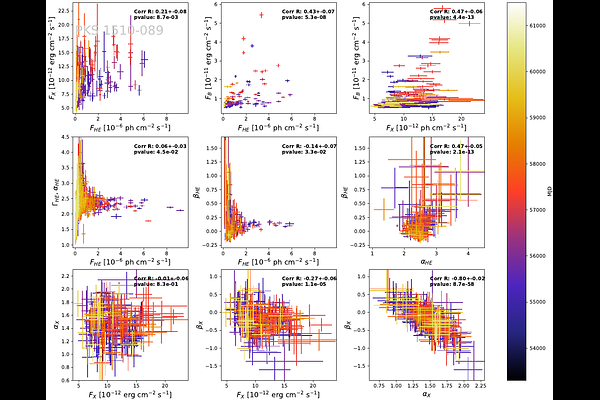
AbstractWe present a comprehensive, two-decade, multiwavelength variability study of the blazar PKS 1510-089, one of the most prominent and extensively monitored flat-spectrum radio quasars. Using Fermi-LAT $γ$-ray data together with Swift-XRT and UVOT observations spanning 2005-2024, we trace the long-term evolution of its flux, interband correlations, and spectral behaviour across the optical, X-ray, and $γ$-ray bands. We find that the HE $γ$-ray and X-ray flux distributions are log-normal, while the optical distributions are compatible with double-log-normal functions. The latter may be due to contributions from the accretion disk. The range of fluxes in a given band, as well as the fractional variability values are in-line with the expectations that high-energy parts of a given spectral component are more variable than low-energy parts. No obvious cross-correlations exist between the bands over the 20 years of observations. The X-ray and $γ$-ray spectra are variable, but do not show any trend with flux. These results are suggestive of different zones being active in the jet of PKS 1510-089 at any given time. In a previous paper, we used the same techniques to study the high-frequency-peaked BL Lac object PKS 2155-304. Both sources follow the aforementioned trend on the energy-dependent variability of the spectral components, as well as the lack of significant cross-correlations between the studied bands. While PKS 2155-304 exhibits a harder-when-brighter behaviour in its high-energy part of the synchrotron component, no such behaviour could be found in PKS 1510-089. Both sources show orphan flares, which can seemingly happen in any band. In summary, the long-term studies of these two sources reveal that the underlying physics is similar in these apparently different source classes, even though variability patterns keep changing and remain unpredictable.