The Diffuse Gamma-ray Sky of a Milky Way Analogue: Local Diversity and Global Constraints

The Diffuse Gamma-ray Sky of a Milky Way Analogue: Local Diversity and Global Constraints
Karin Kjellgren, Philipp Girichidis, Maria Werhahn, Ralf S. Klessen, Christoph Pfrommer, Juan Soler, Brian Reville, Jim Hinton, Patrick Hennebelle, Noé Brucy, Simon C. O. Glover
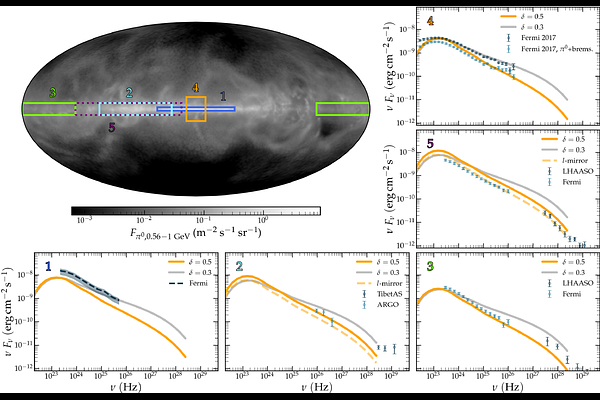
AbstractDiffuse gamma-ray emission is a key tracer of cosmic rays (CRs) in galaxies, encoding information about their transport, energetics, and interactions with the interstellar medium. Interpreting the Milky Way gamma-ray sky is challenging because the observed emission depends on the three-dimensional distributions of CRs and gas, as well as the observer location within the Galaxy. Using the Rhea suite of CR-MHD simulations of a Milky Way analogue, we study how pion-decay gamma-ray emission varies with galactic environment, local conditions, and CR transport physics. Emission is computed in post-processing under steady-state assumptions, enabling analysis of luminosities, spectra, full-sky maps, and angular power spectra (APS) for multiple observer positions, including those inside Local-Bubble-like cavities. The simulated galaxy reproduces Milky Way-like gamma-ray luminosities and spectral slopes without parameter tuning. While total luminosity is relatively stable, the morphology of the gamma-ray sky varies strongly with observer location due to the complex local gas distribution, consistent with observations. For all observers, the APS traces gas column density rather than the smoother CR energy density, in agreement with previous studies. Comparisons with Fermi-LAT data show good agreement in both the all-sky spectrum and APS, with a diffusion coefficient scaling proportional to E^0.5 providing the best match. These results show that key features of Galactic gamma-ray emission arise naturally in self-consistent CR-MHD simulations. Gas density fluctuations primarily shape emission morphology, while CR transport governs spectral and structural properties. The Rhea simulations provide a physically grounded framework for interpreting diffuse gamma-ray observations and highlight the importance of local environment in tracing Galactic CR physics.