Self-Limited Accretion onto Embedded Binaries in a Uniform Medium

Self-Limited Accretion onto Embedded Binaries in a Uniform Medium
Marcus DuPont, Eliot Quataert
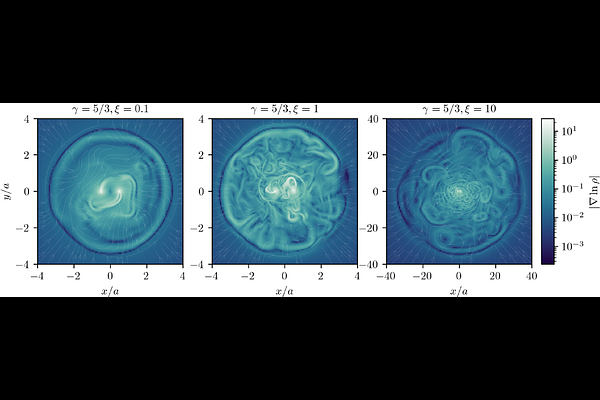
AbstractWe study accretion from a uniform gas at rest onto equal-mass binaries -- the binary Bondi problem -- as a function of adiabatic index~$γ$ and compactness $ξ\equiv R_B/a$, where $R_B$ is the Bondi radius of the binary and $a$ is the component separation. We present three-dimensional hydrodynamic simulations spanning $ξ= \{0.1, 1, 10\}$ at $γ= \{1, 4/3, 5/3\}$. Isothermal gas ($γ= 1$) accretes cooperatively at high compactness, with efficiency $η\equiv \dot{M}_{\rm binary}/\dot{M}_{\rm Bondi} \to 1$ for $ξ\gg 1$ and a stable sonic surface that screens the orbital modulation. Adiabatic gas ($γ> 1$) is self-limiting: the orbit drives shocks that generate entropy, producing convective turbulence that suppresses accretion to $η\approx 0.3$ ($γ= 4/3$) and $η\approx 0.1$ ($γ= 5/3$), burying the orbital signature in broadband noise. We derive a stability criterion from first principles: the sonic surface is the separatrix of the Bondi saddle point, and the binary annihilates it in $N \propto (γ-1)^{-1}(\sqrt{ξ/ξ_m} - 1)$ orbits, where $ξ_m = 4/(5{-}3γ)$ is the container threshold at which the sonic surface first encloses the binary, and the $(γ-1)^{-1}$ divergence follows from the lack of entropy generation at isothermal shocks. For $γ= 5/3$, no saddle point exists at any~$ξ$ and the neutrally stratified Bondi profile is convectively unstable by a distinct mechanism. The single comparison $t_{\rm cool}$ versus $NT$ -- where $T$ is the orbital period -- determines whether an embedded binary accretes cooperatively or throttles its own fuel supply; simulations confirm the analytic thresholds and scaling.