Time-Lag properties associated with LFQPO in X-ray variability classes of GRS 1915+105: Findings from AstroSat

Time-Lag properties associated with LFQPO in X-ray variability classes of GRS 1915+105: Findings from AstroSat
Prajjwal Majumder, Broja G. Dutta, Anuj Nandi
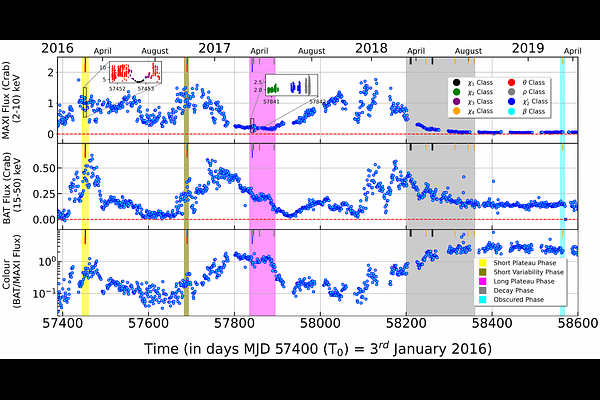
AbstractWe present a comprehensive analysis of Low Frequency Quasi-periodic Oscillation (LFQPO) associated time-lags in the persistently variable black hole binary GRS 1915+105 using 441 ks of \textit{AstroSat} observations from March 2016 to March 2019. LFQPO frequency ($1.38-7.38$ Hz) are detected across the $θ$, $β$, $ρ$, and $χ$ classes, with the $χ$ class further subdivided into $χ_1$, $χ_2$, $χ_3$, and $χ_4$ based on spectro-temporal characteristics. Class transitions occur on timescales of a few hours, appearing either as a simultaneous increase in X-ray count rate and QPO frequency, or vice versa, indicating rapid changes in the accretion flow geometry. The $\text{rms}_{\rm QPO}$ increases with QPO frequency up to $\sim 3.4$ Hz and declines at higher frequencies, a trend similar to \textit{RXTE} observations, where peak occurred at $\sim 2$ Hz. Spectro-temporal correlations reveal that increasing $F_{\rm Comp}$ drives higher $\text{rms}_{\rm QPO}$ and decreases the soft-lag magnitude, while $ν_{\rm QPO}$ and $Γ$ also decline, suggesting that the observed time lag may result from the combined effects of multiple physical mechanisms. The consistent increase of $\text{rms}_{\rm QPO}$ with $F_{\rm Comp}$ provides clear evidence that modulated Comptonized photons enhance the rms power ($\text{rms}_{\rm QPO}$). Moreover, the soft-lag ($1.59-13.49$ ms) observed across all QPO frequencies, without the sign reversal at $\sim$ 2 Hz observed in \textit{RXTE} observations, is interpreted within the framework of a dynamical accretion disk model around the black hole.