Time lags and their association with the Boundary Layer structure in a Z source GX 349+2

Time lags and their association with the Boundary Layer structure in a Z source GX 349+2
Abhishek M. V. R., Sriram K, Gouse SD
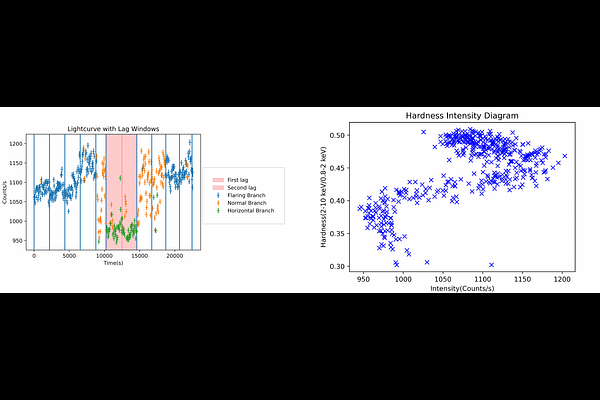
AbstractStudying the cross-correlation function between the soft and hard X-ray emission in Neutron Star Low Mass X-ray Binaries provides crucial insight into the structure and dynamics of the innermost accretion regions. In this work, we investigate the CCF of the Z-source GX 349+2 using an XMM-Newton observation. We noted that asymmetric CCFs with lags of a few hundred secondsbetween soft and hard band LCs in the horizontal branch, whereas CCFs remained symmetric in normal and flaring branches. We also performed a CCF study during the flux transition duration and observed lags of the order of a few tens to hundreds of seconds. Monte Carlo simulations were performed to assess the robustness of these CCFs, confirming their significance at a 95% confidence level. Spectral analysis during the flux transitions further suggests that the inner accretion disk extends close to the last stable orbit. We propose that the observed hard lags arise from the readjustment of the boundary layer/coronal region located near the inner edge of the accretion disk. From the measured lags, we estimate the characteristic size of the boundary layer. We show that the observed lags could also be associated with the depletion timescale of the boundary layer with low viscosity.