Long-term timing of the relativistic binary PSR J1906+0746

Long-term timing of the relativistic binary PSR J1906+0746
L. Vleeschower, B. W. Stappers, M. J. Keith, G. Desvignes, P. C. C. Freire, M. Kramer, J. van Leeuwen, L. Levin, A. G. Lyne, I. H. Stairs, V. Venkatraman Krishnan, Y. Y. Wang
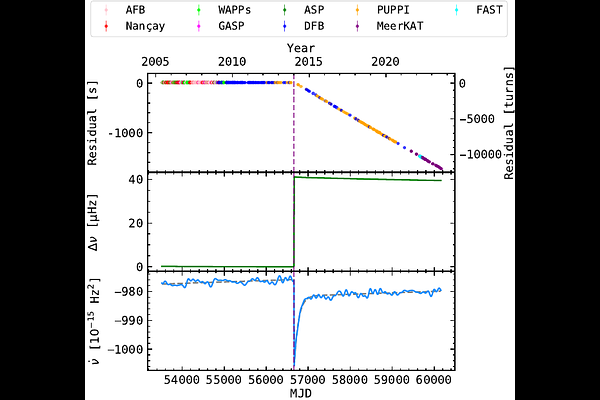
AbstractWe conducted a timing analysis of over 18 years of data on the young ($τ_{\rm c} = 112$ kyr, $P = 114$\,ms) relativistic binary PSR~J1906+0746, using six radio telescopes: Arecibo, FAST, Green Bank, Lovell, MeerKAT, and Nançay. This pulsar is known to orbit a compact high-mass companion with a period of 3.98\,hrs in a mildly eccentric orbit ($e = 0.085$). By combining all data and maintaining a coherent timing solution over the full span, we obtained a more precise measurement of the advance of periastron, $\dotω = 7.5841(2)$\,$°$\,yr$^{-1}$, the Einstein delay, $γ= 4.59(2) \times 10^{-4}$\,s, and the secular change in orbital period, $\dot{P}_{\rm b} = -5.65(2) \times 10^{-13}$\,s\,s$^{-1}$. Assuming the validity of general relativity, we obtain a total mass of 2.6133(1)\,$M_{\odot}$ and component masses of 1.316(5) $M_{\odot}$ for the pulsar and 1.297(5) $M_{\odot}$ for the companion, consistent with a double neutron star system. However, when fitting for the secular change in the projected semi-major axis we obtain $\dot{x} = -1.8(6) \times 10^{-13}$\,s\,s$^{-1}$, the component masses are shifted by $\sim 3.5σ$, which is expected from the correlation of $\dot{x}$ and $γ$. The $\dot{x}$ has a similar magnitude to that observed in PSR~J1141$-$6545, which is due to spin-orbit coupling; if confirmed, it would indicate that, as in the latter system, the companion of the PSR~J1906+0746 system is a massive fast-rotating white dwarf formed before the pulsar. Additionally, we report and characterize a large glitch near MJD 56664, with a fractional frequency increase comparable to those observed in the Vela pulsar.