SN 2024abfl: A Low-Luminosity Type IIP Supernova in NGC 2146 from a Low-Mass Red Supergiant Progenitor

SN 2024abfl: A Low-Luminosity Type IIP Supernova in NGC 2146 from a Low-Mass Red Supergiant Progenitor
Xiaohan Chen, Ning-Chen Sun, Qiang Xi, Chun Chen, Yu Zhang, Zexi Niu, Junjie Jin, Yiming Mao, Beichuan Wang, Samaporn Tinyanont, Krittapas Chanchaiworawit, Kanthanakorn Noysena, David Aguado, Ismael Perez-Fournon, Frédéric Poidevin, Justyn R. Maund, Xunhao Chen, Pengliang Du, David López Fernández-Nespral, Liguo Fang, Guolin Gao, Jiupeng Guo, Min He, Xinyi Hong, Zhigang Hou, Qingzheng Li, Wenxiong Li, Tongyu Liu, Alicia López-Oramas, Haiyang Mu, César Rojas-Bravo, Jianfeng Tian, Jinhui Wang, Lingzhi Wang, Rui Wang, Yanan Wang, Ziyang Wang, Klaas Wiersema, Ying Wu, Guo Zhen, Jie Zheng, Guoyin Zhu, Yinan Zhu, Zhou Fan, Jing Li, Hong Wu, Jifeng Liu
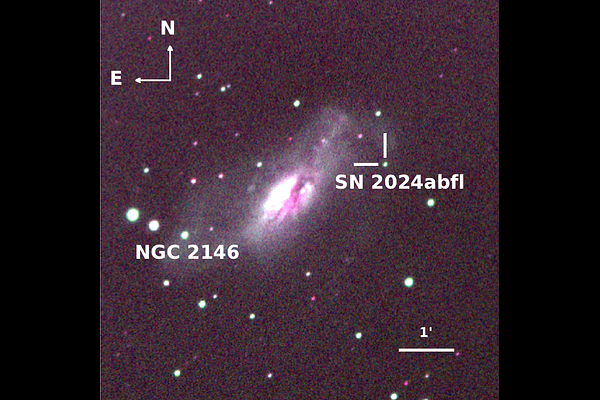
AbstractType IIP supernovae (SNe IIP) exhibit a significant diversity in their explosion properties, yet the physical mechanisms driving this diversity remain unknown. In this work, we present photometric and spectroscopic observations of SN 2024abfl, a SN IIP in NGC 2146 with a directly detected red supergiant (RSG) progenitor. We find it has a low plateau luminosity ($M_V \sim -15$ mag) and a relatively long plateau length ($\sim 126.5$ days). By fitting a semi-analytical model, we estimated a $^{56}$Ni mass of $\sim 0.009 M_\odot$, an initial kinetic energy of $\sim 0.42$ foe, an initial thermal energy of $\sim 0.03$ foe and an ejecta mass of $\sim 8.3 M_\odot$. The spectral evolution of SN 2024abfl is similar to those of other SNe IIP, except for much lower ejecta velocities at similar epochs. At later epochs, we find a relatively high-velocity H$α$ absorption feature at $\sim -4000$ km s$^{-1}$, possibly due to a fast-moving plume of matter in the inner ejecta, and two emission features at $\pm 2000$ km s$^{-1}$, possibly caused by CSM interaction. We estimate the progenitor mass to be $\le 15 M_\odot$ based on nebular spectra. We conclude that SN 2024abfl is a low-luminosity SN IIP originating from a low-mass RSG progenitor.