How Distance Affects GRB Prompt Emission Measurements

How Distance Affects GRB Prompt Emission Measurements
Michael J. Moss, Amy Y. Lien, S. Bradley Cenko, Sylvain Guiriec, Craig B. Markwardt
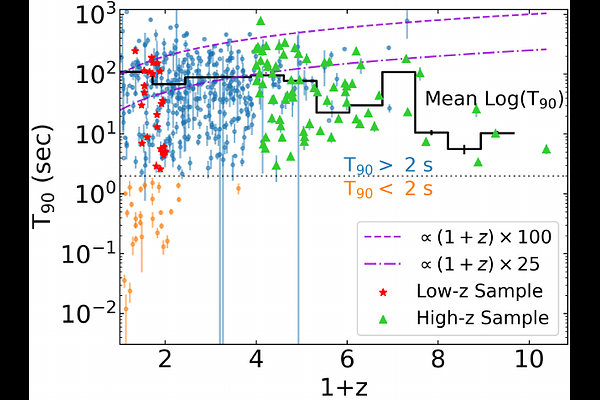
AbstractWe investigated how Gamma-Ray Burst (GRB) prompt emission measurements are affected by increasing distance to the source. We selected a sample of 26 bright GRBs with measured redshifts $z<1$ observed by the Burst Alert Telescope (BAT) on board the Neil Gehrels Swift Observatory (Swift) and simulated what BAT would have observed if the GRBs were at larger redshifts. We measured the durations of the simulated gamma-ray signals using a Bayesian block approach and calculated the enclosed fluences and peak fluxes. As expected, we found that almost all durations (fluences) measured for simulated high-$z$ GRBs were shorter (less) than their true durations (energies) due to low signal-to-noise ratio emission becoming completely dominated by background, i.e., the ``tip-of-the-iceberg'' effect. This effect strongly depends on the profile and intensity of the source light curve. Due to the uniqueness of GRB light curves, there is no common behavior in the evolution of measured durations with redshift. We compared our synthetic high-$z$ (i.e., $z>3$) GRBs to a sample of 72 observed high-$z$ bursts and found that the two samples were not inconsistent with being drawn from the same underlying population. We conclude that: (i) prompt emission durations (fluences) of high-$z$ GRBs observed by Swift/BAT are most likely underestimations, sometimes by factors of $\sim$several tens ($\sim2$), and (ii) changes in the average GRB prompt emission duration and fluence with increasing redshift are consistent with the tip-of-the-iceberg effect.