A Catalogue of Variable Active Galactic Nuclei Based on Multi-Timescale Variability Analysis from Fermi-LAT Data

A Catalogue of Variable Active Galactic Nuclei Based on Multi-Timescale Variability Analysis from Fermi-LAT Data
Luana Passos-Reis, Elisabete M. de Gouveia Dal Pino, Tarek Hassan, Santiago Pita, Alberto Domínguez
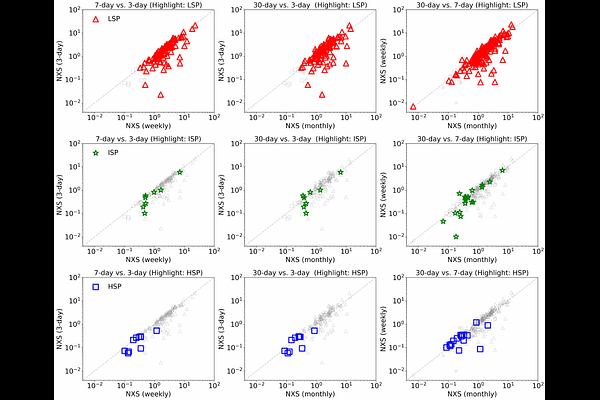
AbstractActive Galactic Nuclei (AGN) sources feature supermassive black holes that launch relativistic plasma jets. They are key $γ$-ray sources providing a unique laboratory for studying extreme particle acceleration and plasma physics. Variability in $γ$-ray emission is an important signature that may constrain the size of the emission region and the physical processes driving flares. However, current large-scale $γ$-ray catalogs, such as the Fermi-LAT 4LAC-DR3, typically characterize variability only on long timescales (yearly or 60-day), lacking necessary constraints on short-term behavior from days to weeks. To address this, we systematically characterize $γ$-ray variability in AGNs across short timescales: 3-day, 7-day (weekly), and 30-day (monthly). We present a preliminary catalogue of variable AGN based on light curves from the Fermi-LAT Light Curve Repository. We show that the variability amplitude ($σ_{\rm NXS}^{2}$) presents similar values across different timescales, potentially increasing for a subsample of sources as the observation timescale increases. This high-cadence analysis reinforces the known dichotomy between flat-spectrum radio quasars (FSRQs) and BL Lacertae objects (BL Lacs), with FSRQs consistently exhibiting stronger variability. By identifying the most luminous and variable sources at each timescale, we highlight key targets for follow-up with next-generation observatories such as the Cherenkov Telescope Array Observatory (CTAO), ASTRI Mini-Array, and the Southern Wide-field Gamma-ray Observatory (SWGO), where strong short-term variability suggests highly compact emission zones and extreme particle acceleration efficiency. This catalogue contributes to the understanding of high-energy outflows in AGN jets and provides a foundation for optimizing observational strategies through a unified variability metric across timescales.