Gas Kinematics and Cosmic-Ray Acceleration in the Gamma-ray SNRs W41 and G22.7-0.2

Gas Kinematics and Cosmic-Ray Acceleration in the Gamma-ray SNRs W41 and G22.7-0.2
Takeru Murase, Hidetoshi Sano, Kohei Matsubara, Yasuo Fukui, Junya Nishi, Sabrina Einecke, Miroslav Filipovic, Rina Kasai, Ren Matsusaka, Gavin Rowell, Hiroshi Sodoh, Hiromasa Suzuki, Yosuke Shibata, Kisetsu Tsuge, Hiroshi Takaba, Toshihiro Handa
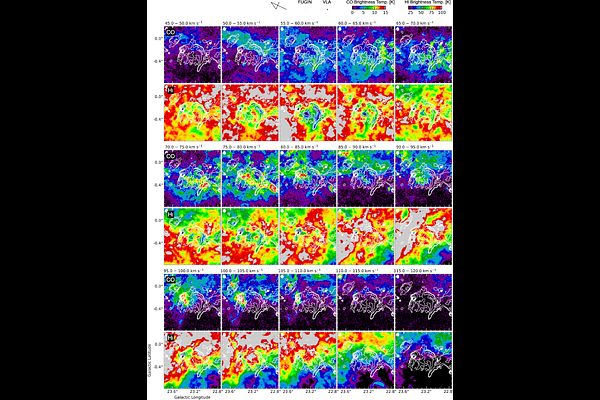
AbstractWe present a study of the interstellar medium associated with the two middle-aged supernova remnants (SNRs) W41 and G22.7-0.2, both detected in TeV gamma-rays. Using high-angular-resolution $^{12}$CO($J$ = 1-0) data from the Nobeyama 45-m telescope and HI data from the VLA, we investigated the spatial and kinematic properties of molecular and atomic gas that interact with the SNRs. We identified associated clouds in the velocity ranges of +50-+80 km s$^{-1}$ for W41 and +76-+110 km s$^{-1}$ for G22.7-0.2. Column density analysis indicates that target protons are dominated by molecular hydrogen, while atomic hydrogen contributes less than $\sim$10-15% even after correction for self-absorption. The mean proton densities are $\sim$1.2$\times$10$^{3}$ cm$^{-3}$ for W41 and $\sim$5.3$\times$10$^{2}$ cm$^{-3}$ for G22.7-0.2. From the gamma-ray luminosities, we estimate the total energy of accelerated cosmic-ray protons as $W_\mathrm{p}$ $\sim$3$\times$10$^{47}$~erg for W41 and $\sim$1$\times$10$^{48}$ erg for G22.7-0.2, corresponding to 0.03-0.1% of the canonical supernova explosion energy. hese $W_\mathrm{p}$ values agree with the decreasing trend in $W_\mathrm{p}$ observed in the middle-aged SNRs within the previously reported SNR age-$W_\mathrm{p}$ relation.