Minijets and Broken Stationarity in a Blazar : Novel Insights into the Origin of $γ$-ray Variability in CTA 102

Minijets and Broken Stationarity in a Blazar : Novel Insights into the Origin of $γ$-ray Variability in CTA 102
Agniva Roychowdhury
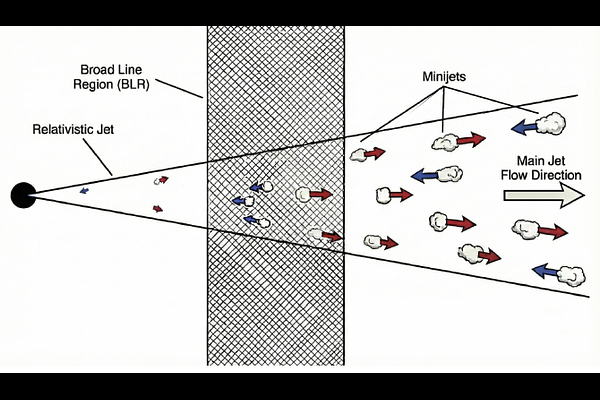
AbstractHigh-energy blazar light curves, in X-rays and beyond, have historically preferred a log-normal flux distribution, signifying multiplicative processes either in the jet itself or due to connection(s) with accretion. Here we present 18 year archival Fermi-LAT light curves (0.1-100 GeV) of the flat spectrum radio quasar (FSRQ) CTA 102 from August 2008 to November 2025, which underwent a huge flare in 2017, with a $\sim$ factor of 100 jump in $γ$-ray flux, along with similar flaring in X-rays. Our statistical analyses confirm that neither the pre nor the post-flare total GeV light curves follow a strictly log-normal distribution. Instead, we observe a statistically significant reduction in skewness from the pre to the post-flare light curves, which implies the blazar transitioned from an energetic state with frequent flaring to a more plateaued state with occasional flaring. We further find that this state transition can be explained through magnetic relaxation, where many reconnection events caused the 2017 flare, after which the magnetic field was ordered and its energy reached a minimum. To explain this further, we use a Monte Carlo simulation of a modified minijets-in-a-jet model where GeV flares are produced only when a maximum number of minijets move toward the broad line region and towards the line of sight, in the context of an external Compton model. The flux distributions (both observed and simulated) could be fit by a modified log-normal power-law distribution, implying our minijets model can reproduce the GeV flares in CTA 102 as well as their flux distributions.