Sensitivity of CTAO to axion-like particles from blazars: a machine learning approach

Sensitivity of CTAO to axion-like particles from blazars: a machine learning approach
Francesco Schiavone Bari Univ INFN Bari, Leonardo Di Venere INFN Bari, Francesco Giordano Bari Univ INFN Bari
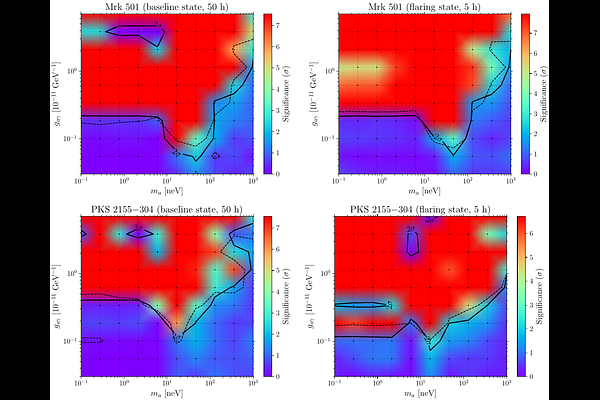
AbstractBlazars are a class of active galactic nuclei, supermassive black holes located at the centres of distant galaxies characterised by strong emission across the entire electromagnetic spectrum, from radio waves to gamma rays. Their relativistic jets, closely aligned to the line of sight from Earth, are a rich and complex environment, characterised by the presence of strong magnetic fields over parsec-scale lengths. Owing to their cosmological distance from Earth, these sources serve as ideal targets to probe non-standard gamma-ray propagation. In particular, axion-like particles (ALPs) could be detected through their coupling to photons, which enables ALP-photon conversions in external magnetic fields, leading to distinct signatures in the blazars' gamma-ray spectra. In this work, we explore a novel approach to constrain the ALP parameter space using gamma-ray observations, based on the use of machine-learning classifiers. We apply this technique to simulated observations of two bright blazars -- Mrk 501 and PKS 2155$-$304 -- with the Cherenkov Telescope Array Observatory (CTAO), a next-generation gamma-ray facility well suited to probe such features, thanks to its improved energy resolution and point-source sensitivity with respect to present ground-based gamma-ray telescopes. The obtained $2σ$ exclusion regions on the ALP parameter space are consistent with those found by applying a standard likelihood-ratio test, and suggest that the CTAO sensitivity to ALPs could be extended beyond existing constraints over a wide mass range.