Einstein Probe Discovery of an X-ray Flare from K-type Star PM J23221-0301

Einstein Probe Discovery of an X-ray Flare from K-type Star PM J23221-0301
Guoying Zhao, WeiKang Zheng, Rong-Feng Shen, Qingcang Shui, Dongyue Li, Chang Zhou, Tianci Zheng, Weimin Yuan, Chong Ge, Junfeng Wang, Alexei V. Filippenko, Thomas G. Brink, Jordan Forman, Mayra Gutierrez, Isabelle Jones, Ravjit Kaur, Naunet Leonhardes-Barboza, Petra Mengistu, Avi Patel, Andrew Skemer, Anavi Uppal, Nicole Wolff, Michele N. Woodland
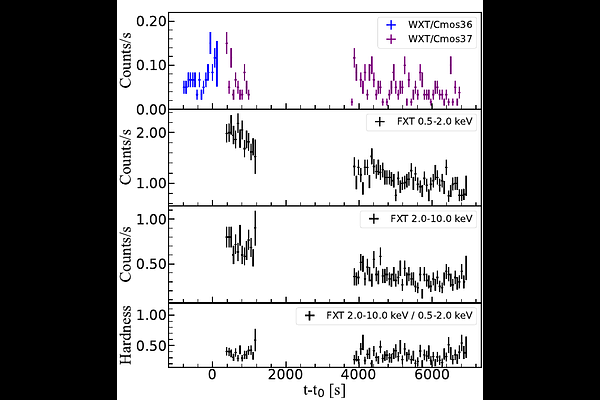
AbstractStellar flares are an intense stellar activity that can significantly impact the atmospheric composition of the surrounding planets and even the possible existence of life. During such events, the radiative energy of the star is primarily concentrated in the optical and X-ray bands, with the X-ray flux potentially increasing by tens or even hundreds of times. Einstein Probe (EP) detected a new X-ray transient EP J2322.1-0301 on 27 September 2024. Its spatial localization shows a high positional coincidence with the nearby high proper motion K-type star PM J23221-0301. Follow-up X-ray observations confirmed the flux enhancement of the source, while optical spectroscopic monitoring revealed time-variable features, particularly the disappearance of the H-alpha emission line. This X-ray flare is consistent with a characteristic fast-rise-exponential-decay (FRED) light curve, with a rise timescale of 1.4 ks, a decay timescale of 5.7 ks, and a total duration of about 7.1 ks. The peak luminosity in the 0.5-4.0 keV energy band reached about 1.3 x 10^31 erg s^-1, with a total energy release of about 9.1 x 10^34 erg, consistent with the empirical energy correlations observed in magnetic-reconnection-driven stellar flares, as inferred from the multitemperature plasma structure and H-alpha-X-ray energy correlation. This discovery underscores EP's capability in understanding stellar magnetic activity via observing stellar transients.