Wind-mediated Eddington-limited emission in a 1e4 Black Hole Tidal Disruption Event

Wind-mediated Eddington-limited emission in a 1e4 Black Hole Tidal Disruption Event
Paola Martire, Elena Maria Rossi, Nicholas Chamberlain Stone, Elad Steinberg, Konstantinos Kilmetis, Itai Linial
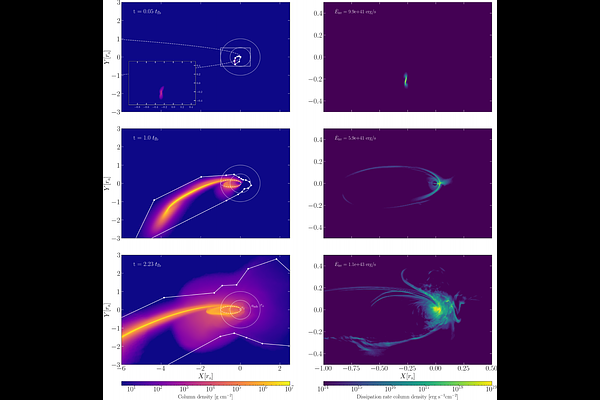
AbstractObservations of tidal disruption events (TDEs) have already produced tens of strong candidate flares, and their number will greatly increase with upcoming wide field surveys. Nevertheless, the origin of the measured luminosity peak at early times is still unknown, and the ultimate sources of energy dissipation in TDEs are not fully understood. Here we present the first three-dimensional end-to-end simulation of a TDE by a $10^{4}M_\odot$ intermediate mass black hole (IMBH) with realistic parameters, run with the radiation-hydrodynamics code RICH. We find that the stellar debris fails to circularize efficiently, while a low-density, radiation-driven wind forms near pericenter and expands quasi-spherically. Radiation is advected by this outflow and released at the photosphere, which expands to radii of $\approx10^{13}$ cm and reaches temperatures of ~few $10^{4}$K at the peak of the light curve. The resulting luminosity briefly exceeds the Eddington limit before settling near that value. We systematically test the numerical convergence of our simulation by running it at three resolutions. While the nozzle shock at pericenter may be under-resolved, we find that global results are qualitatively converged and, largely, quantitatively robust. The upcoming Vera Rubin Observatory's LSST (g and r band) and ULTRASAT (near UV) will be able to observe events like our simulated IMBH TDE up to redshifts of z$\approx$0.1 and z$\approx$0.06, respectively.