The impact of Solar magnetic field configurations on the production of gamma rays at the Solar disk

The impact of Solar magnetic field configurations on the production of gamma rays at the Solar disk
Julien Dörner, Frederic Effenberger, Horst Fichtner, Julia Becker Tjus, Meng Jin, Wei Liu, Vahe' Petrosian
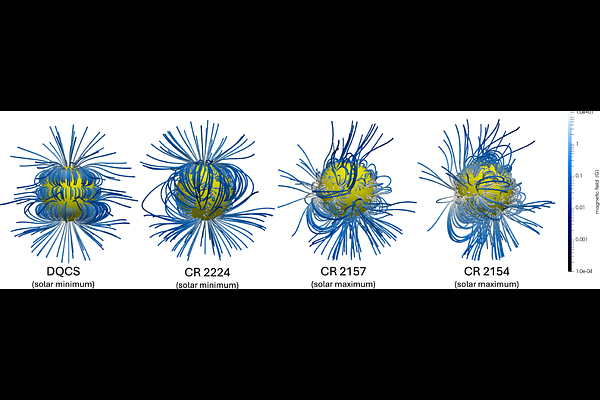
AbstractThe Sun produces a steady signal of high-energy gamma rays through interactions of Galactic cosmic rays (GCRs) with its atmosphere. Observations with Fermi-LAT and HAWC have revealed a gamma-ray flux significantly higher than early theoretical predictions, with unexpected temporal and spectral features that suggest a crucial role of the solar magnetic field. In this work, we model GCR-induced gamma-ray emission at the solar disk using the CRPropa framework with realistic hadronic interactions, chromospheric density profiles, and several magnetic field configurations over the solar cycle. This allows us to quantify the gamma-ray emission of the entire solar disk for different phases of the solar activity cycle and we present, for the first time, maps of the production locations of gamma rays on the solar surface. We consider both mono-energetic and realistic power-law injection spectra in a simplified dipole-quadrupole current sheet model and potential-field source surface (PFSS) extrapolations for Carrington rotations during solar maximum and minimum. Our results show that magnetic mirroring and large-scale field topology strongly affect the spectral shape and spatial distribution of the emission, with slightly enhanced fluxes predicted at solar minimum. While our simulated baseline fluxes remain below observations, additional effects, such as heavier nuclei, Parker-field mirroring, and deeper atmospheric interactions, could result in further enhancements of fluxes closer to observational values. Hadronic interactions do not only produce gamma rays but also neutrinos. We estimate the expected neutrino flux from the Sun based on our gamma-ray predictions. We find that the expected flux is slightly below current upper limits from IceCube.