Fast Radio Bursts from White Dwarf Binary Mergers: Isolated and Triple-Induced Channels

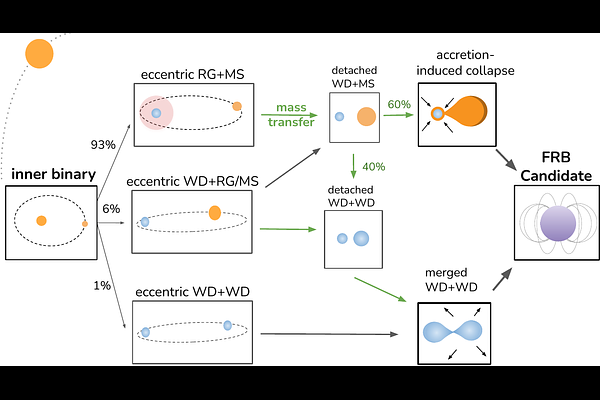
Fast Radio Bursts from White Dwarf Binary Mergers: Isolated and Triple-Induced Channels
Cheyanne Shariat, Claire S. Ye, Smadar Naoz, Sanaea Rose
AbstractThe detection of fast radio bursts (FRBs) in both young and old stellar populations suggests multiple formation pathways, beyond just young magnetars from core-collapse supernovae. A promising delayed channel involves the formation of FRB-emitting neutron stars through merger- or accretion-induced collapse of a massive white dwarf (WD). By simulating a realistic stellar population with both binaries and triples, we identify pathways to WD collapse that could produce FRB candidates. We find that (i) triple dynamics open new merger channels inaccessible to isolated binaries, significantly enhancing the overall merger rate; (ii) triple-induced mergers broaden the delay-time distribution, producing long-delay ($\gtrsim1$-8~Gyr) events largely independent of metallicity, alongside a shorter-delay population ($\lesssim100$~Myr) of rapid mergers; (iii) these long delays naturally yield FRBs in older environments such as quiescent host galaxies and galactic halos; (iv) when convolved with the cosmic star-formation history, binary channels track the star-formation rate ($z_{\rm peak} \sim 2$), while triple channels peak later ($z_{\rm peak} \sim 1$), giving a combined local source rate of $R_0 \approx 2\times10^4~{\rm Gpc^{-3}~yr^{-1}}$, consistent with observations; and (v) applying the same framework to Type~Ia supernovae, we find that triples extend the delay-time tail and roughly double the Ia efficiency relative to binaries, yielding rates and redshift evolution in good agreement with observations. If FRBs originate from the collapse of WDs, our results establish triples, alongside binaries, as a crucial and previously overlooked formation pathway whose predicted rates, host demographics, and redshift evolution offer clear tests for upcoming surveys.