Lucky Strikes: On the Origins of GW190814 Through Isolated Binary Evolution

Lucky Strikes: On the Origins of GW190814 Through Isolated Binary Evolution
Ignacio Magaña Hernandez, Katelyn Breivik
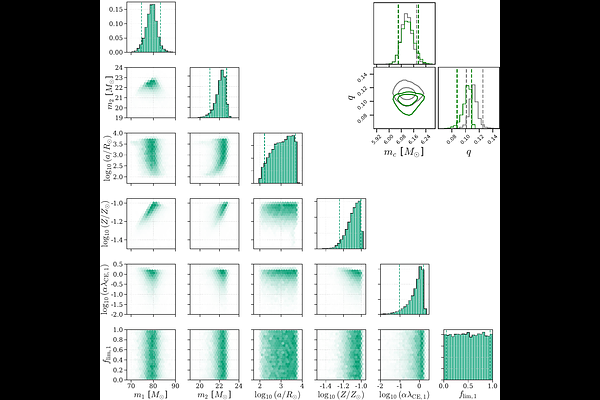
AbstractThe asymmetric nature of GW190814, particularly its mass ratio ($q \approx 1/10$), has made its astrophysical origin elusive. We explore isolated binary evolution as a potential explanation for GW190814's formation. Using the binary population synthesis code COSMIC, and the backpop sampling technique to map the observed parameters of GW190814 to the initial conditions of Zero Age Main Sequence binary stars while simultaneously inferring the astrophysical prescriptions for common envelope evolution, stable mass transfer and natal kick kinematics that are needed for its formation and eventual merger. We find that the initial conditions for the binary stellar population that forms GW190814 do not stand out significantly from massive star populations observed in the Local Group. Our backpop simulations recover a dominant formation pathway where the first Roche overflow phase includes a common envelope evolution and the second Roche overflow phase remains stable. Our findings suggest that natal kicks imparted during compact object formation play the strongest role in forming GW190814-like systems. Specifically, our models require a low magnitude first natal kick (independent of direction) that prevents the binary from unbinding and a large second natal kick with its direction in the plane of the orbit and toward the binary's center of mass. The second natal kick strength and direction crucially increases the orbital eccentricity, leading to shorter delay times, and thus enabling mergers within a Hubble time. We estimate the chance probability for GW190814-like events that experience such a lucky kick and find that it occurs in $\sim20\%$ of systems if natal kicks are randomly oriented. We discuss the astrophysical implications for the formation of asymmetric GW190814-like systems under the context of binary stellar evolution.