Spin-Orbit Misalignments of Eccentric Black Hole Mergers in AGN Disks

Spin-Orbit Misalignments of Eccentric Black Hole Mergers in AGN Disks
Gaia Fabj, Christopher Tiede, Connar Rowan, Martin Pessah, Johan Samsing
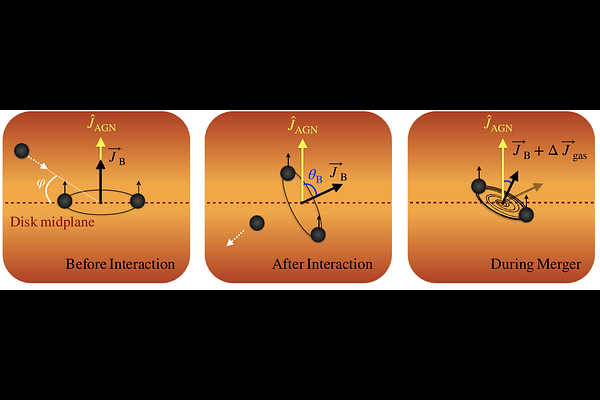
AbstractThe disks of active galactic nuclei (AGNs) provide a natural environment where stellar-mass black holes (BHs) can dynamically pair, undergo repeated interactions, and eventually merge. It is commonly assumed that gas accretion will both efficiently spin up disk-embedded black holes and align the orbits of embedded binaries with the disk plane, leading to mergers with preferentially positive effective spin parameters ($\chi_{\mathrm{eff}}$). Such predictions have motivated the use of $\chi_{\mathrm{eff}}$ as a diagnostic for identifying candidate AGN-embedded mergers in the LIGO-Virgo-KAGRA gravitational-wave catalog. In this work, we perform post-Newtonian $N$-body simulations of nearly planar binary-single encounters and apply an empirically motivated, gas-driven alignment prescription to characterize the expected $\chi_{\mathrm{eff}}$-eccentricity correlations of AGN-embedded mergers. By comparing the alignment and gravitational-wave inspiral timescales, we identify the regions of parameter space, across both disk location and binary properties, where full disk-spin-orbit alignment is effective and where it is not. We find that quasi-circular binaries typically align by the time they merge, supporting the standard picture of spin-orbit aligned orientations. By contrast, eccentric binaries (with in-band eccentricity $e_{10\mathrm{Hz}}\gtrsim 0.1$) typically inspiral too quickly for gas torques to act, preserving the post-encounter spin-orbit misalignments and yielding more isotropic $\chi_{\mathrm{eff}}$ distributions when disk densities and torque efficiencies are modest. This interplay naturally establishes a correlation between binary eccentricity and $\chi_{\mathrm{eff}}$ in AGN disks, highlighting a new key observable of the AGN channel and a potential explanation for massive events such as GW190521 and GW231123.