Impact of black hole spin on low-mass black hole-neutron star mergers

Impact of black hole spin on low-mass black hole-neutron star mergers
Rahime Matur, Ian Hawke, Nils Andersson
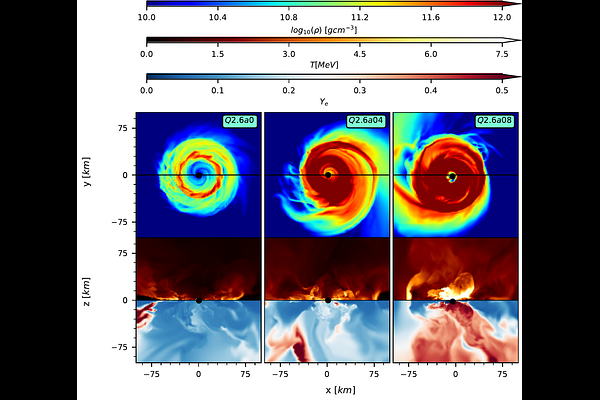
AbstractThe recent detection of GW230529 suggests that black hole-neutron star mergers may involve low-mass black holes, potentially producing detectable electromagnetic counterparts. Motivated by this, we perform eleven fully general-relativistic hydrodynamic simulations with and without neutrino treatment, targeting the inferred chirp mass of GW230529. We systematically vary the black hole spin from $a_{\mathrm{BH}} = 0.0$ to $0.8$ in steps of $0.1$, making this the most comprehensive study of spin effects in black hole-neutron star mergers to date. We confirm our earlier findings of fast-moving ejecta ($v \geq 0.6\,c$) in this parameter regime and demonstrate a clear spin dependence, with fast-ejecta masses reaching up to $\qty{\sim e-3}{\Mass\Sun}$ for $a_{\mathrm{BH}} = 0.8$. Most notably, we identify for the first time the presence of spiral wave-driven ejecta in black hole-neutron star mergers -- a phenomenon previously reported only in binary neutron star systems. The mass of this component grows significantly with spin, reaching levels up to $\qty{\sim 7e-3}{\Mass\Sun}$. These results establish a new spin-enhanced mechanism for powering blue kilonova emission in black hole-neutron star mergers, significantly extending the range of systems expected to produce observable electromagnetic counterparts.