Illuminating Hidden Pulsars: Scintillation-Enhanced Discovery of Two Binary Millisecond Pulsars in M13 with FAST

Illuminating Hidden Pulsars: Scintillation-Enhanced Discovery of Two Binary Millisecond Pulsars in M13 with FAST
Dejiang Yin, Lin Wang, Li-yun Zhang, Lei Qian, Baoda Li, Kuo Liu, Bo Peng, Yinfeng Dai, Yaowei Li, Zhichen Pan
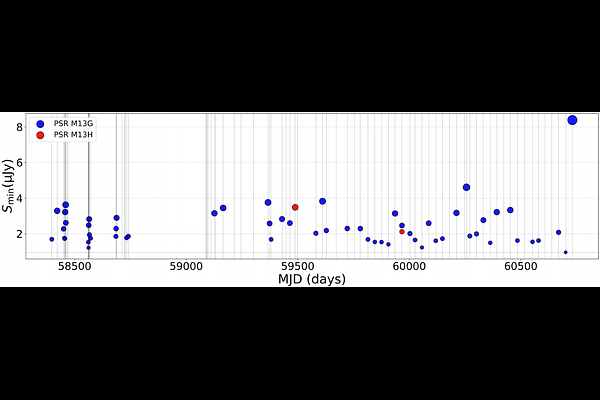
AbstractWe conducted a sensitive acceleration search using Fast Fourier Transform (FFT) techniques on full-length and segmented data from 84 observations of the globular cluster M13 with the Five-hundred-meter Aperture Spherical radio Telescope (FAST). Employing a low detection threshold (2 $\sigma$) to maximize sensitivity to faint pulsars, here we report the discovery of two binary millisecond pulsars: J1641+3627G (M13G) and J1641+3627H (M13H). Both pulsars were detected during scintillation-brightened states, revealing systems that would otherwise remain undetected. For M13G, we obtained a phase-connected timing solution spanning 6.4 years, identifying it as a black widow system with an orbital period of 0.12 days hosting an extremely low-mass companion ($\sim 9.9\times 10^{-3}~{ M}_\odot$), though no eclipses were observed. M13H, however, shows significant apparent acceleration but was detected in only 2 of 84 observations; its extremely low detection rate currently prevents constraints on orbital parameters or classification.