Effects of Eccentricity on Accreting Binary Black Holes: MHD Simulations in Full GR Reveal Novel Periodicities in Jet Power and Synchrotron Spectra

Effects of Eccentricity on Accreting Binary Black Holes: MHD Simulations in Full GR Reveal Novel Periodicities in Jet Power and Synchrotron Spectra
Vikram Manikantan, Vasileios Paschalidis, Gabriele Bozzola
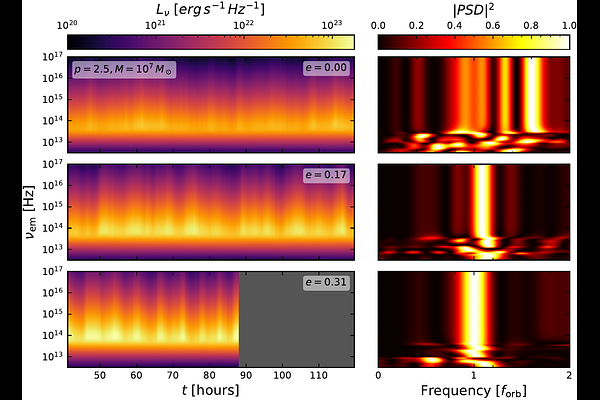
AbstractWe perform simulations of magnetohydrodynamic accretion onto equal-mass, non-spinning binary black holes in 3+1 full general relativity addressing the effects of orbital eccentricity. We find that binary black holes with non-negligible eccentricity accrete matter with periodicity that matches the binary orbital period, whereas quasi-circular binaries exhibit accretion rate modulation at approximately $\sim 0.7\times$ their binary orbital period. Additionally, we find that the total jet luminosity is modulated at the orbital period for eccentric binaries, while quasi-circular binaries only exhibit long-term modulations. We perform a radiative transfer calculation of the dual jet synchrotron emission and demonstrate that the optically thin synchrotron emission varies on the binary orbital period for eccentric binaries. Moreover, eccentric binaries spend more time in a low state, where the synchrotron emission is minimum, than in a high state, where the synchrotron emission peaks. The quasi-circular binary also exhibits variability in its optically thin synchrotron emission but the exact frequency of variability does not appear robust against different parameters. Our suite of simulations is an essential step towards providing a comprehensive catalog of multi-messenger theoretical models that will enable studies of supermassive binary black holes detectable across the electromagnetic and gravitational wave spectra.