Study of Multi-Wavelength Variability, Emission Mechanism and Quasi-Periodic Oscillation for Transition Blazar S5 1803+784

Study of Multi-Wavelength Variability, Emission Mechanism and Quasi-Periodic Oscillation for Transition Blazar S5 1803+784
Javaid Tantry, Ajay Sharma, Zahir Shah, Naseer Iqbal, Debanjan Bose
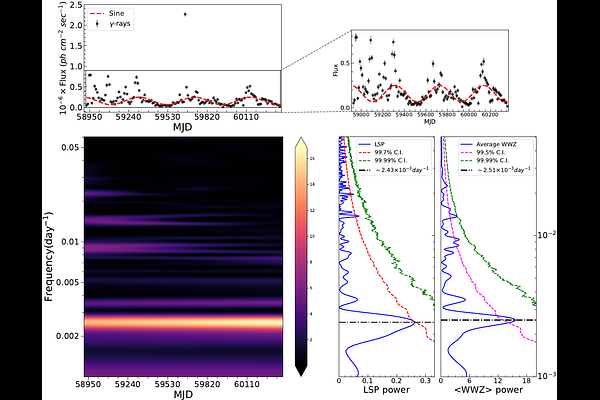
AbstractThis work present the results of a multi-epoch observational study of the blazar S5\,1803+784, carried out from 2019 to 2023. The analysis is based on simultaneous data obtained from the Swift/UVOT/XRT, ASAS-SN, and Fermi-LAT instruments. A historically high $\gamma$-ray flux observed for this source on march 2022 ($\mathrm{2.26\pm0.062)\times10^{-6}~phcm^{-2}s^{-1}}$. This study investigates the $\gamma$-ray emission from a blazar, revealing a dynamic light curve with four distinct flux states: quiescent and high-flux by using the Bayesian Blocks (BB) algorithm. A potential transient quasi-periodic signal with an oscillation timescale of $\sim$411 days was identified, showing a local significance level surpassing 99.7$\%$ from the Lomb-Scargle Periodogram (LSP) and Damped Random Walk (DRW) analysis and exceeds 99.5$\%$ from the Weighted Wavelet Z-Transform (WWZ) analysis. The observed QPO was confirmed through an autoregressive process (AR(1)), with a significance level exceeding 99$\%$, suggesting a potential physical mechanism for such oscillations involves a helical motion of a magnetic plasma blob within the relativistic jet. Log parabola modeling of the $\gamma$-ray spectrum revealed a photon index ($\alpha_\gamma$) variation of 1.65$\pm$0.41 to 2.48$\pm$0.09 with a steepening slope, potentially indicative of particle cooling, changes in radiative processes, or modifications in the physical parameters. The $\alpha_\gamma$ of 2.48$\pm$0.09 may hint at an evolutionary transition state from BL\,Lac to FSRQ. A comparative analysis of variability across different energy bands reveals that Optical/UV and GeV emissions display greater variability compared to X-rays. Broadband SED modeling shows that within a one-zone leptonic framework, the SSC model accurately reproduces flux states without external Compton contributions, highlighting magnetic fields crucial role.