Spectropolarimetry of A Nuclear Transient AT2023clx: Revealing The Geometrical Alignment between The Transient Outflow and The Nuclear Dusty Region

Spectropolarimetry of A Nuclear Transient AT2023clx: Revealing The Geometrical Alignment between The Transient Outflow and The Nuclear Dusty Region
Kohki Uno, Keiichi Maeda, Takashi Nagao, Giorgos Leloudas, Panos Charalampopoulos, Seppo Mattila, Kentaro Aoki, Kenta Taguchi, Miho Kawabata, Javier Moldon, Miguel Pérez-Torres, Miika Pursiainen, Thomas Reynolds
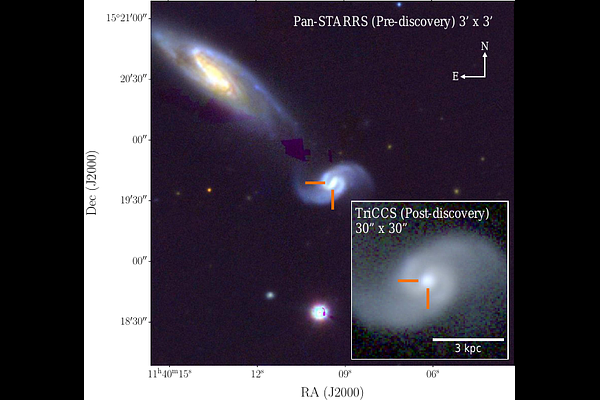
AbstractAT2023clx, which occurred in NGC3799 with a Low-Ionization Nuclear Emission-Line Region (LINER), is one of the most nearby nuclear transients classified as a tidal disruption event (TDE). We present three-epoch spectropolarimetric follow-up observations of AT2023clx. We detected two polarization components; one is a constant polarization of $\sim 1\%$ originated from an aspherical outflow associated with the transient, while the other is a blue-excess polarization up to $\sim 2\%$ originated from a nuclear dusty environment via light echoes. Between the two epochs, the polarization angle flipped by 90 degrees, indicating that the direction of the outflow was aligned perpendicular to the dust plane. Such polarization features -- the blue excess and the 90-degree flip -- have never been observed in previous TDE polarization samples, highlighting unique mechanisms behind AT2023clx. We propose possible scenarios to naturally explain the polarization features: the disruption of a star captured by a nuclear dusty cloud around the black hole or a star formed within the cloud. Given the LINER nature of NGC3799, the dusty region may possibly be linked to a torus or disk associated with a weak Active Galactic Nucleus (AGN). Furthermore, as a more speculative scenario, the event might have been triggered by AGN-like activity, potentially linked to changing-look AGNs or ambiguous nuclear transients.