EP240414a: A Gamma-Ray Burst Jet Weakened by an Extended Circumstellar Material

EP240414a: A Gamma-Ray Burst Jet Weakened by an Extended Circumstellar Material
Hamid Hamidani, Yuri Sato, Kazumi Kashiyama, Masaomi Tanaka, Kunihito Ioka, Shigeo S. Kimura
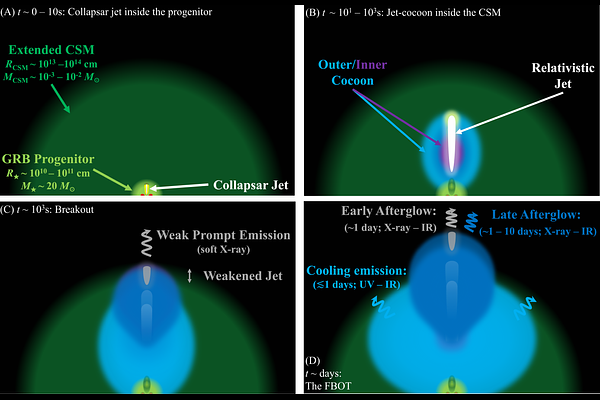
AbstractThe recent Einstein Probe (EP) event EP240414a exhibits several unusual observational features. Its prompt and afterglow emissions place it between long gamma-ray bursts (LGRBs) and low-luminosity GRBs (LLGRBs). The event is followed by a fast optical transient (AT~2024gsa), initially exhibiting a thermal-like spectrum but later evolving into an unusually red peak at $\sim 3-5$ days, which is difficult to explain with thermal emission. Using our generalized analytic framework for jet propagation in a circumstellar material (CSM; Hamidani et al. 2025), we explore a scenario in which a conventional LGRB jet is launched in a progenitor surrounded by a dense CSM. For a CSM of $\sim 0.03 M_\odot$ extending to $\sim 3\times 10^{13}$ cm, we find that the jet is significantly weakened before breaking out, becoming ``barely failed'', an intermediate state between successful (LGRB) and completely failed (LLGRB) jets. This scenario naturally explains EP240414a's multi-wavelength observations, with the early thermal component produced by cocoon cooling emission, and the red peak explained by non-thermal afterglow emission from the mildly relativistic barely failed jet (and its inner cocoon). Our work demonstrates the important role of extended CSM in shaping GRB jets and illustrates how early multi-wavelength follow-up observations can reveal the physically diverse nature of jet-driven transients.