Spectral analysis of the X-ray flares in the 2023 outburst of the new black binary transient Swift J1727.8--1613 observed with Insight-HXMT

Spectral analysis of the X-ray flares in the 2023 outburst of the new black binary transient Swift J1727.8--1613 observed with Insight-HXMT
Jia-Ying Cao, Jin-Yuan Liao, Shuang-Nan Zhang, Hua Feng, Jin-Lu Qu, Liang Zhang, He-Xin Liu, Wei Yu, Qing-Chang Zhao, Jing-Qiang Peng, Ming-Yu Ge, Lian Tao, Yan-Jun Xu, Shu Zhang, Zi-Xu Yang
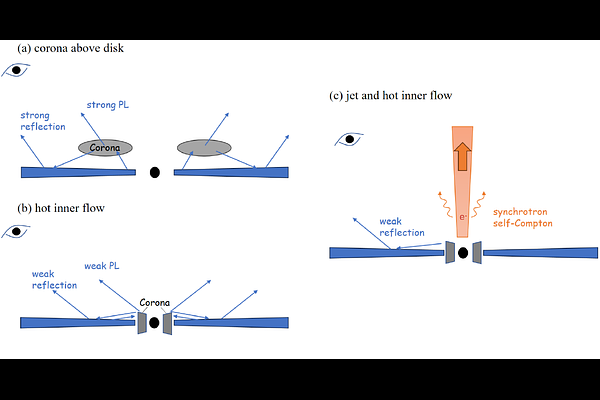
AbstractThe new black hole transient Swift J1727.8--1613 exhibited a series of X-ray flares during its 2023 outburst extensively observed with Insight-HXMT. We analyze the spectra of the flaring period using a series of models consisting of a multi-color disk and several different non-thermal components, and several consistent conclusions are obtained among these models. First, Swift J1727.8--1613 was in the transition process from the hard intermediate state (HIMS) to the very high state (VHS) during the first flaring period (MJD 60197--60204), and afterwards it exhibited typical VHS parameter characteristics, such as high temperature of the disk inner radius and a steep power-law spectrum with a photon index of 2.6. Second, the flares in the VHS are characterized by a rapid increase in the flux of accretion disk, accompanied by a simultaneous rapid expansion of the inner radius, which could be apparent if the accretion disk hardening factor varies significantly. The strong power-law component during the VHS is likely produced by synchrotron self-Compton process in the relativistic jets, in agreement with the observed weak reflection component and lack of correlation with the disk component.