Revealing two orthogonally polarized spectral components in Vela X-1 with IXPE

Revealing two orthogonally polarized spectral components in Vela X-1 with IXPE
Sofia V. Forsblom, Sergey S. Tsygankov, Valery F. Suleimanov, Alexander A. Mushtukov, Juri Poutanen
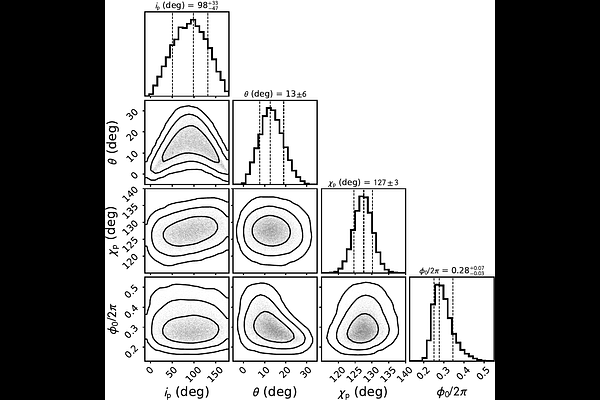
AbstractPolarimetric observations of X-ray pulsars (XRPs) have provided us with the key to unlocking their geometrical properties. Thanks to the Imaging X-ray Polarimetry Explorer (IXPE) the geometries of several XRPs have been determined, providing new insights into their emission mechanisms and magnetic field structures. Previously, Vela X-1 has proven to be exceptional in demonstrating a clear energy dependence of its polarimetric properties, showing a 90$^{\circ}$ swing in the polarization angle (PA) between low and high energies. Due to the complex energy-dependent nature of the polarization properties, it was not possible to determine the pulsar geometry. In this work, we present the results of a detailed analysis of the pulse phase-resolved polarization properties of at different energies. By separating the polarimetric analysis into low and high energy ranges, we are able to disentangle the contributions of the soft and hard spectral components to the polarization, revealing the pulse phase dependence of polarization degree (PD) and PA in each energy band. The PA pulse phase dependence at high energies (5$-$8 keV) allows us, for the first time, to determine the pulsar geometry in Vela X-1. The fit with the rotating vector model gives an estimate for the pulsar spin position angle at around 127$^{\circ}$ and for the magnetic obliquity of 13$^{\circ}$. In order to explain the 90$^{\circ}$ swing in PA between high and low energies, we discuss two possible scenarios: a two-component spectral model and the vacuum resonance.