X-ray emission from helium star+black hole binaries as probes of tidally induced spin-up of second-born black holes

X-ray emission from helium star+black hole binaries as probes of tidally induced spin-up of second-born black holes
Koushik Sen Institute of Astronomy, Faculty of Physics, Astronomy and Informatics, Nicolaus Copernicus University, Torun, Poland Steward Observatory, Department of Astronomy, University of Arizona, Tucson, AZ, USA, Aleksandra Olejak Max Planck Institute for Astrophysics, Garching, Germany, Sambaran Banerjee Helmholtz-Instituts für Strahlen- und Kernphysik, Bonn, Germany Argelander-Institut für Astronomie, Bonn, Germany
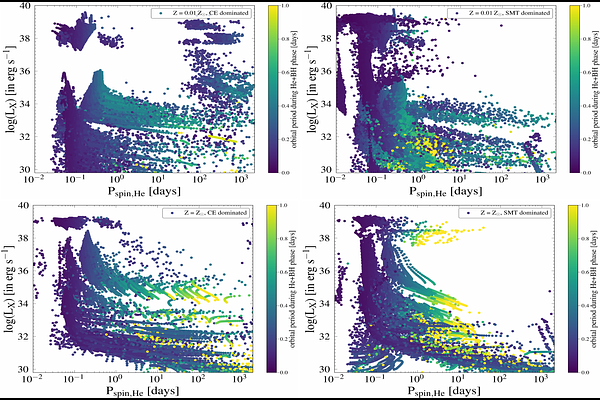
AbstractTidally induced spin-up of stripped helium stars in short-period (<\,1\,d) binaries with black holes has been presented as one of the possible mechanisms to reproduce the high-spin tail of the black hole spin distribution derived from gravitational wave (GW) merger observations. At such short periods, a fraction of the strong stellar wind from the stripped helium stars may be accreted by the black holes, and its gravitational potential energy may be released as observable radiation in the X-ray regime. We estimate the X-ray luminosity and its observability from black holes in orbit with stripped helium stars, which evolve into binary black hole or black hole+neutron star binaries that merge within Hubble time. We post-process recent advancements for estimating X-ray luminosities (via wind accretion onto stellar mass black holes) into two rapid population synthesis codes, BSE and StarTrack. We derive lower limits on the X-ray luminosity distribution from populations of stripped helium+black hole binaries at four metallicities (0.01, 0.1, 0.5, 1 $Z_{\odot}$) and two mass transfer stability criteria. We find that a large fraction (0.1-0.5) of stripped-helium stars that get spun up by tides also transfer enough wind matter onto the black hole to produce X-ray luminosities above $10^{35}$\,erg\,s$^{-1}$, up to $\sim10^{39}$\,erg\,s$^{-1}$. Such binaries should be observable as X-ray bright systems at 0.1\,$Z_{\odot}$, 0.5\,$Z_{\odot}$ and $Z_{\odot}$, representative of Sextans A, the Large Magellanic Cloud (LMC) and the Solar neighbourhood, respectively. The formation efficiency of these systems increases with decreasing metallicity. However, accounting for the local star formation rates, our population synthesis predicts $\sim$2 and $\sim$1 such observable binaries in the Milky Way and LMC, respectively, that will produce a binary compact object merger within a Hubble time. (Abridged)