
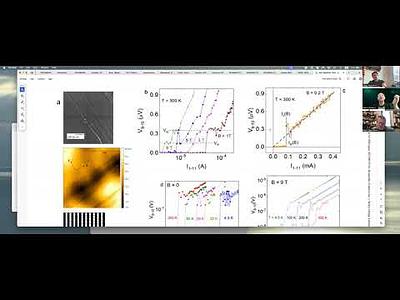
By: Y. V. Kopelevich, J. H. S. Torres, R. Ricardo da Silva, M. C. Diamantini, C. A. Trugenbergerand, V. M. Vinokur
Room temperature superconductivity under normal conditions has been a major
challenge of physics and material science since its very discovery. Here we
report the global room-temperature superconductivity observed in cleaved highly
oriented pyrolytic graphite carrying dense arrays of nearly parallel surface
line defects. The multiterminal measurements performed at the ambient pressure
in the temperature interval 4.5 K < T < 300 K and at mag... more
Room temperature superconductivity under normal conditions has been a major
challenge of physics and material science since its very discovery. Here we
report the global room-temperature superconductivity observed in cleaved highly
oriented pyrolytic graphite carrying dense arrays of nearly parallel surface
line defects. The multiterminal measurements performed at the ambient pressure
in the temperature interval 4.5 K < T < 300 K and at magnetic fields 0 < B < 9
T applied perpendicular to the basal graphitic planes reveal that the
superconducting critical current I_c(T,B) is governed by the normal state
resistance RN(T, B) so that I_c(T,B) is proportional to 1/R_N(T, B).
Magnetization M(T, B) measurements of superconducting screening and hysteresis
loops together with the critical current oscillations with temperature that are
characteristic for superconductor-ferromagnet-superconductor Josephson chains,
provide strong support for occurrence of superconductivity at T > 300 K. We
develop a theory of global superconductivity emerging in the array of linear
structural defects which well describes the experimental findings and
demonstrate that global superconductivity arises as a global phase coherence of
superconducting granules in linear defects promoted by the stabilizing effect
of underlying Bernal graphite via tunneling coupling to the three dimensional
(3D) material.
less
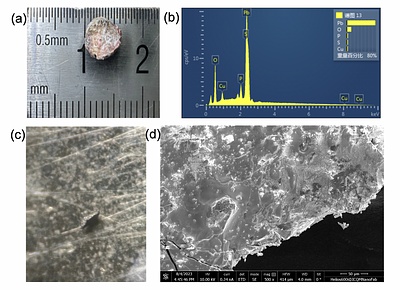
By: Hongyang Wang, Yao Yao, Ke Shi, Yijing Zhao, Hao Wu, Zhixing Wu, Zhihui Geng, Shufeng Ye, Ning Chen
With copper-substituted lead apatite below room temperature, we observe
diamagnetic dc magnetization under magnetic field of 25 Oe with remarkable
bifurcation between zero-field-cooling and field-cooling measurements, and
under 200 Oe it changes to be paramagnetism. A glassy memory effect is found
during cooling. Typical hysteresis loops for superconductors are detected below
250 K, along with an asymmetry between forward and backward sweep... more
With copper-substituted lead apatite below room temperature, we observe
diamagnetic dc magnetization under magnetic field of 25 Oe with remarkable
bifurcation between zero-field-cooling and field-cooling measurements, and
under 200 Oe it changes to be paramagnetism. A glassy memory effect is found
during cooling. Typical hysteresis loops for superconductors are detected below
250 K, along with an asymmetry between forward and backward sweep of magnetic
field. Our experiment suggests at room temperature the Meissner effect is
possibly present in this material.
less
By: Kaizhen Guo, Yuan Li, Shuang Jia
We successfully synthesized polycrystalline LK-99-like ceramic samples with a
solid-state-sintering method. Powder X-ray diffraction shows that the main
contents are $\mathrm{Pb_{10-x}Cu_x(PO_4)_6O}$ and $\mathrm{Cu_2S}$, consistent
with recent reports [arXiv:2307.12037; arXiv:2308.01192]. In some small flaky
fragments, we successfully observed ``half levitation'' atop a
$\mathrm{Nd_2Fe_{14}B}$ magnet. Using magnetization measurements on su... more
We successfully synthesized polycrystalline LK-99-like ceramic samples with a
solid-state-sintering method. Powder X-ray diffraction shows that the main
contents are $\mathrm{Pb_{10-x}Cu_x(PO_4)_6O}$ and $\mathrm{Cu_2S}$, consistent
with recent reports [arXiv:2307.12037; arXiv:2308.01192]. In some small flaky
fragments, we successfully observed ``half levitation'' atop a
$\mathrm{Nd_2Fe_{14}B}$ magnet. Using magnetization measurements on such small
pieces, as well as on a large piece which does not exhibit the half levitation,
we show that the samples ubiquitously contain weak yet definitive soft
ferromagnetic components. We argue that, together with the pronounced shape
anisotropy of the small fragments, the soft ferromagnetism is sufficient to
explain the observed half levitation in strong vertical magnetic fields. Our
measurements do not indicate the presence of the Meissner effect, nor zero
resistance, in our samples, leading us to believe that our samples do not
exhibit superconductivity.
less
By: Andrew McCalip and collaborators
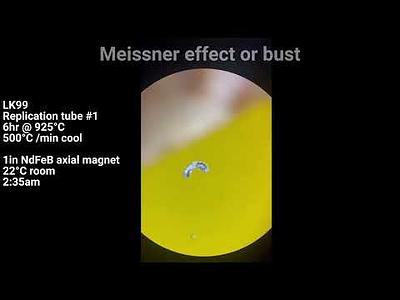
A material called LK-99, a modified-lead apatite crystal structure with the composition Pb$_{10-x}$Cu$_x$(PO$_4$)$_6$O ($0.9<x<1.1$), was reported to behave as a room-Tc superconductor.
Andrew McCalip and a "do-it-yourself" (DIY) team working in their off hours in El Segundo, CA area chronicled their journey to make and test LK-99 on their own. Demonstrated possible "Meissner effect" levitation with a magnet at room temperature.
A material called LK-99, a modified-lead apatite crystal structure with the composition Pb$_{10-x}$Cu$_x$(PO$_4$)$_6$O ($0.9<x<1.1$), was reported to behave as a room-Tc superconductor.
Andrew McCalip and a "do-it-yourself" (DIY) team working in their off hours in El Segundo, CA area chronicled their journey to make and test LK-99 on their own. Demonstrated possible "Meissner effect" levitation with a magnet at room temperature.
less
By: Hao Wu, Li Yang, Bichen Xiao, Haixin Chang
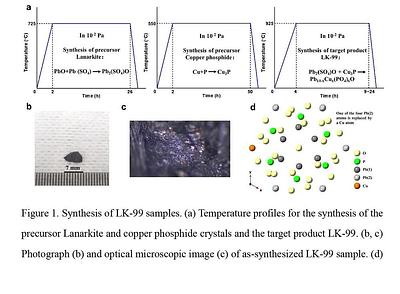
Recently, Sukbae Lee et al. reported inspiring experimental findings on the atmospheric superconductivity of a modified lead apatite crystal (LK-99) at room temperature (10.6111/JKCGCT.2023.33.2.061, arXiv: 2307.12008, arXiv:2307.12037). They claimed that the synthesized LK-99 materials exhibit the Meissner levitation phenomenon of superconductors and have a superconducting
transition temperature (Tc) higher than 400 K. Here, for the first ... more
Recently, Sukbae Lee et al. reported inspiring experimental findings on the atmospheric superconductivity of a modified lead apatite crystal (LK-99) at room temperature (10.6111/JKCGCT.2023.33.2.061, arXiv: 2307.12008, arXiv:2307.12037). They claimed that the synthesized LK-99 materials exhibit the Meissner levitation phenomenon of superconductors and have a superconducting
transition temperature (Tc) higher than 400 K. Here, for the first time, we successfully verify and synthesize the LK-99 crystals which can be magnetically levitated with larger levitated angle than Sukbae Lee's sample at room temperature. It is expected to realize the true potential of room temperature, non-contact superconducting magnetic levitation in near future.
less
By: Qiang Hou, Wei Wei, Xin Zhou, Yue Sun, Zhixiang Shi
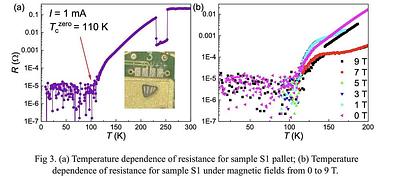
Room-temperature superconductivity has always been regarded as the ultimate goal in the fields of solid-state physics and materials science, with its realization holding revolutionary significance, capable of triggering significant changes in energy transmission and storage. However, achieving it poses various challenges. Recent research revealed that material Pb$_{10-x}$Cu$_x$(PO$_4$)$_6$O displays room-temperature superconductivity under ... more
Room-temperature superconductivity has always been regarded as the ultimate goal in the fields of solid-state physics and materials science, with its realization holding revolutionary significance, capable of triggering significant changes in energy transmission and storage. However, achieving it poses various challenges. Recent research revealed that material Pb$_{10-x}$Cu$_x$(PO$_4$)$_6$O displays room-temperature superconductivity under atmospheric pressure, sparking global interest in further exploration. Here, we utilized solid-phase synthesis to obtain a polycrystalline sample of
Pb$_{10-x}$Cu$_x$(PO$_4$)$_6$O. X-ray diffraction confirmed its structural consistency with referenced literature. Zero resistance, which is important evidence for superconductivity, was observed above 100$^\circ$ K under ambient pressure in our experiment. Our finding indicates that Pb$_{10-x}$Cu$_x$(PO$_4$)$_6$O is a possible candidate for searching high-temperature superconductors.
less
By: Bianca Turini, Sedighe Salimian, Matteo Carrega, Andrea Iorio, Elia Strambini, Francesco Giazotto, Valentina Zannier, Lucia Sorba, Stefan Heun
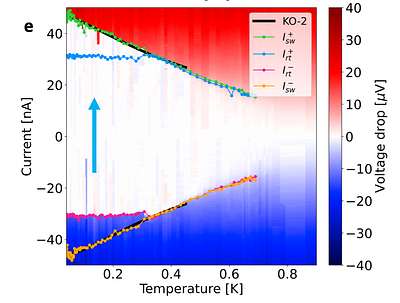
We report evidence of non-reciprocal dissipation-less transport in single
ballistic InSb nanoflag Josephson junctions, owing to a strong spin-orbit
coupling. Applying an in-plane magnetic field, we observe an inequality in
supercurrent for the two opposite current propagation directions. This
demonstrates that these devices can work as Josephson diodes, with
dissipation-less current flowing in only one direction. For small fields, the
super... more
We report evidence of non-reciprocal dissipation-less transport in single
ballistic InSb nanoflag Josephson junctions, owing to a strong spin-orbit
coupling. Applying an in-plane magnetic field, we observe an inequality in
supercurrent for the two opposite current propagation directions. This
demonstrates that these devices can work as Josephson diodes, with
dissipation-less current flowing in only one direction. For small fields, the
supercurrent asymmetry increases linearly with the external field, then it
saturates as the Zeeman energy becomes relevant, before it finally decreases to
zero at higher fields. We show that the effect is maximum when the in-plane
field is perpendicular to the current vector, which identifies Rashba
spin-orbit coupling as the main symmetry-breaking mechanism. While a variation
in carrier concentration in these high-quality InSb nanoflags does not
significantly influence the diode effect, it is instead strongly suppressed by
an increase in temperature. Our experimental findings are consistent with a
model for ballistic short junctions and show that the diode effect is intrinsic
to this material. Our results establish InSb Josephson diodes as a useful
element in superconducting electronics.
less

By: Sukbae Lee, Jihoon Kim, Hyun-Tak Kim, Sungyeon Im, SooMin An, Keun Ho Auh
A material called LK-99, a modified-lead apatite crystal structure with the composition Pb$_{10-x}$Cu$_x$(PO$_4$)$_{6O}$ ($0.9<x<1.1$), has been synthesized using the solid-state method. The material exhibits the Ohmic metal characteristic of Pb(6s1) above its superconducting critical temperature, $T_c$, and the levitation phenomenon as Meissner effect of a superconductor at room temperature and atmospheric pressure below $T_c$. A LK-99 sam... more
A material called LK-99, a modified-lead apatite crystal structure with the composition Pb$_{10-x}$Cu$_x$(PO$_4$)$_{6O}$ ($0.9<x<1.1$), has been synthesized using the solid-state method. The material exhibits the Ohmic metal characteristic of Pb(6s1) above its superconducting critical temperature, $T_c$, and the levitation phenomenon as Meissner effect of a superconductor at room temperature and atmospheric pressure below $T_c$. A LK-99 sample shows $T_c$ above 126.85$^\circ$C (400 K). We analyze that the possibility of
room-temperature superconductivity in this material is attributed to two factors: the first being the volume contraction resulting from an insulator-metal transition achieved by substituting Pb with Cu, and the second being on-site repulsive Coulomb interaction enhanced by the structural deformation in the one-dimensional(D) chain (Pb2-O$_{1/2}$-Pb2 along the c-axis) structure owing to superconducting condensation at $T_c$. The mechanism of the room-temperature $T_c$ is discussed by 1-D BR-BCS theory.
less
By: Nilesh P. Salke, Alexander C. Mark, Muhtar Ahart, Russell J. Hemley
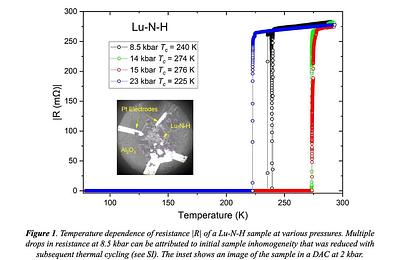
The recent report of superconductivity in nitrogen-doped lutetium hydride at near-ambient pressures and temperatures has attracted great attention but also continuing controversy. Several experimental groups have reported no observation of superconductivity at these conditions in Lu-N-H samples they have prepared. To address this issue, we have carried out a series of studies of phases in the Lu-N-H system using a variety of techniques. We ... more
The recent report of superconductivity in nitrogen-doped lutetium hydride at near-ambient pressures and temperatures has attracted great attention but also continuing controversy. Several experimental groups have reported no observation of superconductivity at these conditions in Lu-N-H samples they have prepared. To address this issue, we have carried out a series of studies of phases in the Lu-N-H system using a variety of techniques. We report here
electrical resistance measurements on a Lu-N-H sample that are in very good agreement with both previously reported Tc and its pressure dependence in the vicinity of room temperature for nitrogen-doped lutetium hydride.
less