
By: Wei Yao, Yuhong Liu, Fadi P. Deek, Guiling Wang
The rapid development of intelligent transportation systems and connected vehicles has highlighted the need for secure and efficient key management systems (KMS). In this paper, we introduce VDKMS (Vehicular Decentralized Key Management System), a novel Decentralized Key Management System designed specifically as an infrastructure for Cellular Vehicular-to-Everything (V2X) networks, utilizing a blockchain-based approach. The proposed VDKMS ... more
The rapid development of intelligent transportation systems and connected vehicles has highlighted the need for secure and efficient key management systems (KMS). In this paper, we introduce VDKMS (Vehicular Decentralized Key Management System), a novel Decentralized Key Management System designed specifically as an infrastructure for Cellular Vehicular-to-Everything (V2X) networks, utilizing a blockchain-based approach. The proposed VDKMS addresses the challenges of secure communication, privacy preservation, and efficient key management in V2X scenarios. It integrates blockchain technology, Self-Sovereign Identity (SSI) principles, and Decentralized Identifiers (DIDs) to enable secure and trustworthy V2X applications among vehicles, infrastructures, and networks. We first provide a comprehensive overview of the system architecture, components, protocols, and workflows, covering aspects such as provisioning, registration, verification, and authorization. We then present a detailed performance evaluation, discussing the security properties and compatibility of the proposed solution, as well as a security analysis. Finally, we present potential applications in the vehicular ecosystem that can leverage the advantages of our approach. less
By: Kun Li, Shengling Wang, Hongwei Shi, Xiuzhen Cheng, Minghui Xu
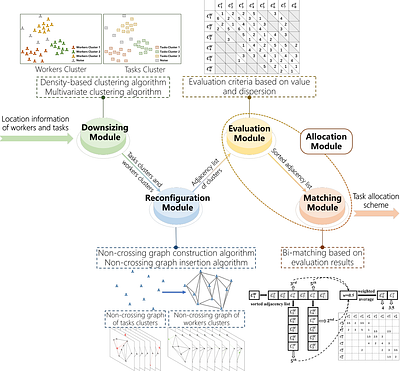
Spatial crowdsourcing (SC) engages large worker pools for location-based tasks, attracting growing research interest. However, prior SC task allocation approaches exhibit limitations in computational efficiency, balanced matching, and participation incentives. To address these challenges, we propose a graph-based allocation framework optimized for massive heterogeneous spatial data. The framework first clusters similar tasks and workers sep... more
Spatial crowdsourcing (SC) engages large worker pools for location-based tasks, attracting growing research interest. However, prior SC task allocation approaches exhibit limitations in computational efficiency, balanced matching, and participation incentives. To address these challenges, we propose a graph-based allocation framework optimized for massive heterogeneous spatial data. The framework first clusters similar tasks and workers separately to reduce allocation scale. Next, it constructs novel non-crossing graph structures to model balanced adjacencies between unevenly distributed tasks and workers. Based on the graphs, a bidirectional worker-task matching scheme is designed to produce allocations optimized for mutual interests. Extensive experiments on real-world datasets analyze the performance under various parameter settings. less

By: Truong Thao Nguyen, Balazs Gerofi, Edgar Josafat Martinez-Noriega, François Trahay, Mohamed Wahib
This paper proposes a method for hiding the least-important samples during the training of deep neural networks to increase efficiency, i.e., to reduce the cost of training. Using information about the loss and prediction confidence during training, we adaptively find samples to exclude in a given epoch based on their contribution to the overall learning process, without significantly degrading accuracy. We explore the converge properties w... more
This paper proposes a method for hiding the least-important samples during the training of deep neural networks to increase efficiency, i.e., to reduce the cost of training. Using information about the loss and prediction confidence during training, we adaptively find samples to exclude in a given epoch based on their contribution to the overall learning process, without significantly degrading accuracy. We explore the converge properties when accounting for the reduction in the number of SGD updates. Empirical results on various large-scale datasets and models used directly in image classification and segmentation show that while the with-replacement importance sampling algorithm performs poorly on large datasets, our method can reduce total training time by up to 22% impacting accuracy only by 0.4% compared to the baseline. Code available at https://github.com/TruongThaoNguyen/kakurenbo less
Adaptive Workload Distribution for Accuracy-aware DNN Inference on Collaborative Edge Platforms
0upvotes
By: Zain Taufique, Antonio Miele, Pasi Liljeberg, Anil Kanduri
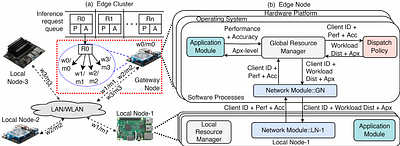
DNN inference can be accelerated by distributing the workload among a cluster of collaborative edge nodes. Heterogeneity among edge devices and accuracy-performance trade-offs of DNN models present a complex exploration space while catering to the inference performance requirements. In this work, we propose adaptive workload distribution for DNN inference, jointly considering node-level heterogeneity of edge devices, and application-specifi... more
DNN inference can be accelerated by distributing the workload among a cluster of collaborative edge nodes. Heterogeneity among edge devices and accuracy-performance trade-offs of DNN models present a complex exploration space while catering to the inference performance requirements. In this work, we propose adaptive workload distribution for DNN inference, jointly considering node-level heterogeneity of edge devices, and application-specific accuracy and performance requirements. Our proposed approach combinatorially optimizes heterogeneity-aware workload partitioning and dynamic accuracy configuration of DNN models to ensure performance and accuracy guarantees. We tested our approach on an edge cluster of Odroid XU4, Raspberry Pi4, and Jetson Nano boards and achieved an average gain of 41.52% in performance and 5.2% in output accuracy as compared to state-of-the-art workload distribution strategies. less
By: Mohammad Goudarzi, Maria A. Rodriguez, Majid Sarvi, Rajkumar Buyya
Fog and Edge computing extend cloud services to the proximity of end users, allowing many Internet of Things (IoT) use cases, particularly latency-critical applications. Smart devices, such as traffic and surveillance cameras, often do not have sufficient resources to process computation-intensive and latency-critical services. Hence, the constituent parts of services can be offloaded to nearby Edge/Fog resources for processing and storage.... more
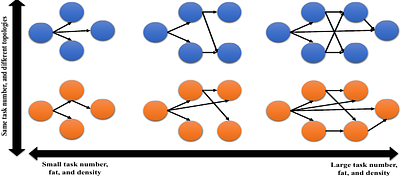
Fog and Edge computing extend cloud services to the proximity of end users, allowing many Internet of Things (IoT) use cases, particularly latency-critical applications. Smart devices, such as traffic and surveillance cameras, often do not have sufficient resources to process computation-intensive and latency-critical services. Hence, the constituent parts of services can be offloaded to nearby Edge/Fog resources for processing and storage. However, making offloading decisions for complex services in highly stochastic and dynamic environments is an important, yet difficult task. Recently, Deep Reinforcement Learning (DRL) has been used in many complex service offloading problems; however, existing techniques are most suitable for centralized environments, and their convergence to the best-suitable solutions is slow. In addition, constituent parts of services often have predefined data dependencies and quality of service constraints, which further intensify the complexity of service offloading. To solve these issues, we propose a distributed DRL technique following the actor-critic architecture based on Asynchronous Proximal Policy Optimization (APPO) to achieve efficient and diverse distributed experience trajectory generation. Also, we employ PPO clipping and V-trace techniques for off-policy correction for faster convergence to the most suitable service offloading solutions. The results obtained demonstrate that our technique converges quickly, offers high scalability and adaptability, and outperforms its counterparts by improving the execution time of heterogeneous services. less
By: Jérémie Decouchant, Burcu Kulahcioglu Ozkan, Yanzhuo Zhou
Byzantine consensus protocols aim at maintaining safety guarantees under any network synchrony model and at providing liveness in partially or fully synchronous networks. However, several Byzantine consensus protocols have been shown to violate liveness properties under certain scenarios. Existing testing methods for checking the liveness of consensus protocols check for time-bounded liveness violations, which generate a large number of fal... more
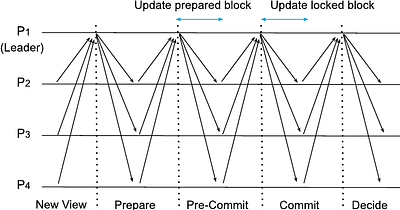
Byzantine consensus protocols aim at maintaining safety guarantees under any network synchrony model and at providing liveness in partially or fully synchronous networks. However, several Byzantine consensus protocols have been shown to violate liveness properties under certain scenarios. Existing testing methods for checking the liveness of consensus protocols check for time-bounded liveness violations, which generate a large number of false positives. In this work, for the first time, we check the liveness of Byzantine consensus protocols using the temperature and lasso detection methods, which require the definition of ad-hoc system state abstractions. We focus on the HotStuff protocol family that has been recently developed for blockchain consensus. In this family, the HotStuff protocol is both safe and live under the partial synchrony assumption, while the 2-Phase Hotstuff and Sync HotStuff protocols are known to violate liveness in subtle fault scenarios. We implemented our liveness checking methods on top of the Twins automated unit test generator to test the HotStuff protocol family. Our results indicate that our methods successfully detect all known liveness violations and produce fewer false positives than the traditional time-bounded liveness checks. less
By: Chao Feng, Alberto Huertas Celdran, Janosch Baltensperger, Enrique Tomas Matınez Bertran, Gerome Bovet, Burkhard Stiller
The rapid integration of Federated Learning (FL) into networking encompasses various aspects such as network management, quality of service, and cybersecurity while preserving data privacy. In this context, Decentralized Federated Learning (DFL) emerges as an innovative paradigm to train collaborative models, addressing the single point of failure limitation. However, the security and trustworthiness of FL and DFL are compromised by poisoni... more
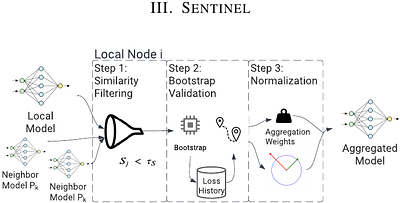
The rapid integration of Federated Learning (FL) into networking encompasses various aspects such as network management, quality of service, and cybersecurity while preserving data privacy. In this context, Decentralized Federated Learning (DFL) emerges as an innovative paradigm to train collaborative models, addressing the single point of failure limitation. However, the security and trustworthiness of FL and DFL are compromised by poisoning attacks, negatively impacting its performance. Existing defense mechanisms have been designed for centralized FL and they do not adequately exploit the particularities of DFL. Thus, this work introduces Sentinel, a defense strategy to counteract poisoning attacks in DFL. Sentinel leverages the accessibility of local data and defines a three-step aggregation protocol consisting of similarity filtering, bootstrap validation, and normalization to safeguard against malicious model updates. Sentinel has been evaluated with diverse datasets and various poisoning attack types and threat levels, improving the state-of-the-art performance against both untargeted and targeted poisoning attacks. less

By: Paul Nuyujukian
Critical goals of scientific computing are to increase scientific rigor, reproducibility, and transparency while keeping up with ever-increasing computational demands. This work presents an integrated framework well-suited for data processing and analysis spanning individual, on-premises, and cloud environments. This framework leverages three well-established DevOps tools: 1) Git repositories linked to 2) CI/CD engines operating on 3) conta... more
Critical goals of scientific computing are to increase scientific rigor, reproducibility, and transparency while keeping up with ever-increasing computational demands. This work presents an integrated framework well-suited for data processing and analysis spanning individual, on-premises, and cloud environments. This framework leverages three well-established DevOps tools: 1) Git repositories linked to 2) CI/CD engines operating on 3) containers. It supports the full life-cycle of scientific data workflows with minimal friction between stages--including solutions for researchers who generate data. This is achieved by leveraging a single container that supports local, interactive user sessions and deployment in HPC or Kubernetes clusters. Combined with Git repositories integrated with CI/CD, this approach enables decentralized data pipelines across multiple, arbitrary computational environments. This framework has been successfully deployed and validated within our research group, spanning experimental acquisition systems and computational clusters with open-source, purpose-built GitLab CI/CD executors for slurm and Google Kubernetes Engine Autopilot. Taken together, this framework can increase the rigor, reproducibility, and transparency of compute-dependent scientific research. less
By: Michael Hu Yiqing, Guangda Sun, Arun Fu, Akasha Zhu, Jialin Li
Logical clocks are a fundamental tool to establish causal ordering of events in a distributed system. They have been used as the building block in weakly consistent storage systems, causally ordered broadcast, distributed snapshots, deadlock detection, and distributed system debugging. However, prior logical clock constructs fail to work in a permissionless setting with Byzantine participants. In this work, we introduce Chrono, a novel logi... more
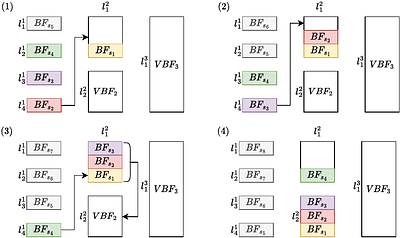
Logical clocks are a fundamental tool to establish causal ordering of events in a distributed system. They have been used as the building block in weakly consistent storage systems, causally ordered broadcast, distributed snapshots, deadlock detection, and distributed system debugging. However, prior logical clock constructs fail to work in a permissionless setting with Byzantine participants. In this work, we introduce Chrono, a novel logical clock system that targets an open and decentralized network. Chrono introduces a new logical clock construct, the Decaying Onion Bloom Clock (DOBC), that scales independently to the size of the network. To tolerate Byzantine behaviors, Chrono leverages non-uniform incrementally verifiable computation (IVC) to efficiently prove and verify the construction of DOBC clocks. We have applied Chrono to build two decentralized applications, a weakly consistent key-value store and an anti-censorship social network, demonstrating the power of scalable, verifiable causality in a decentralized network. less
By: Paolo Burgio, Gianluca Brilli
The rise of power-efficient embedded computers based on highly-parallel accelerators opens a number of opportunities and challenges for researchers and engineers, and paved the way to the era of edge computing. At the same time, advances in embedded AI for object detection and categorization such as YOLO, GoogleNet and AlexNet reached an unprecedented level of accuracy (mean-Average Precision - mAP) and performance (Frames-Per-Second - FPS)... more
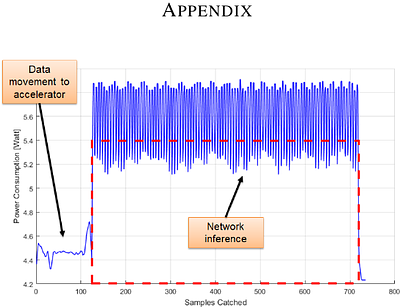
The rise of power-efficient embedded computers based on highly-parallel accelerators opens a number of opportunities and challenges for researchers and engineers, and paved the way to the era of edge computing. At the same time, advances in embedded AI for object detection and categorization such as YOLO, GoogleNet and AlexNet reached an unprecedented level of accuracy (mean-Average Precision - mAP) and performance (Frames-Per-Second - FPS). Today, edge computers based on heterogeneous many-core systems are a predominant choice to deploy such systems in industry 4.0, wearable devices, and - our focus - autonomous driving systems. In these latter systems, engineers struggle to make reduced automotive power and size budgets co-exist with the accuracy and performance targets requested by autonomous driving. We aim at validating the effectiveness and efficiency of most recent networks on state-of-the-art platforms with embedded commercial-off-the-shelf System-on-Chips, such as Xavier AGX, Tegra X2 and Nano for NVIDIA and XCZU9EG and XCZU3EG of the Zynq UltraScale+ family, for the Xilinx counterpart. Our work aims at supporting engineers in choosing the most appropriate CNN package and computing system for their designs, and deriving guidelines for adequately sizing their systems. less