By: Alexander Pondaven, Ziyi Wu, Igor Gilitschenski, Philip Torr, Sergey Tulyakov, Fabio Pizzati, Aliaksandr Siarohin
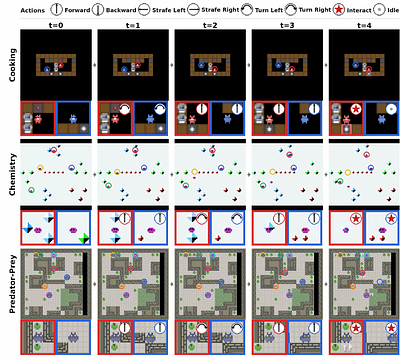
Recent advances in video diffusion have enabled the development of "world models" capable of simulating interactive environments. However, these models are largely restricted to single-agent settings, failing to control multiple agents simultaneously in a scene. In this work, we tackle a fundamental issue of action binding in existing video diffusion models, which struggle to associate specific actions with their corresponding subjects. For t... more
Recent advances in video diffusion have enabled the development of "world models" capable of simulating interactive environments. However, these models are largely restricted to single-agent settings, failing to control multiple agents simultaneously in a scene. In this work, we tackle a fundamental issue of action binding in existing video diffusion models, which struggle to associate specific actions with their corresponding subjects. For this purpose, we propose ActionParty, an action controllable multi-subject world model for generative video games. It introduces subject state tokens, i.e. latent variables that persistently capture the state of each subject in the scene. By jointly modeling state tokens and video latents with a spatial biasing mechanism, we disentangle global video frame rendering from individual action-controlled subject updates. We evaluate ActionParty on the Melting Pot benchmark, demonstrating the first video world model capable of controlling up to seven players simultaneously across 46 diverse environments. Our results show significant improvements in action-following accuracy and identity consistency, while enabling robust autoregressive tracking of subjects through complex interactions. less
By: Hai X. Pham, David T. Hoffmann, Ricardo Guerrero, Brais Martinez
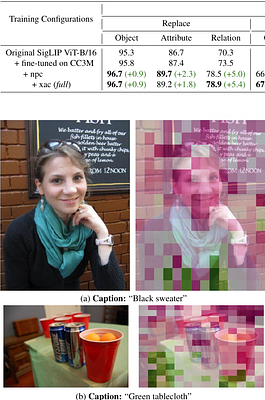
Contrastive vision-language (V&L) models remain a popular choice for various applications. However, several limitations have emerged, most notably the limited ability of V&L models to learn compositional representations. Prior methods often addressed this limitation by generating custom training data to obtain hard negative samples. Hard negatives have been shown to improve performance on compositionality tasks, but are often specific to a si... more
Contrastive vision-language (V&L) models remain a popular choice for various applications. However, several limitations have emerged, most notably the limited ability of V&L models to learn compositional representations. Prior methods often addressed this limitation by generating custom training data to obtain hard negative samples. Hard negatives have been shown to improve performance on compositionality tasks, but are often specific to a single benchmark, do not generalize, and can cause substantial degradation of basic V&L capabilities such as zero-shot or retrieval performance, rendering them impractical. In this work we follow a different approach. We identify two root causes that limit compositionality performance of V&Ls: 1) Long training captions do not require a compositional representation; and 2) The final global pooling in the text and image encoders lead to a complete loss of the necessary information to learn binding in the first place. As a remedy, we propose two simple solutions: 1) We obtain short concept centric caption parts using standard NLP software and align those with the image; and 2) We introduce a parameter-free cross-modal attention-pooling to obtain concept centric visual embeddings from the image encoder. With these two changes and simple auxiliary contrastive losses, we obtain SOTA performance on standard compositionality benchmarks, while maintaining or improving strong zero-shot and retrieval capabilities. This is achieved without increasing inference cost. We release the code for this work at https://github.com/SamsungLabs/concept_centric_clip. less
By: Shang-Jui Ray Kuo, Paola Cascante-Bonilla
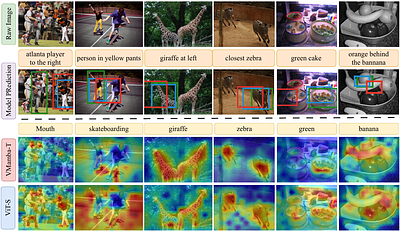
Large vision--language models (VLMs) often use a frozen vision backbone, whose image features are mapped into a large language model through a lightweight connector. While transformer-based encoders are the standard visual backbone, we ask whether state space model (SSM) vision backbones can be a strong alternative. We systematically evaluate SSM vision backbones for VLMs in a controlled setting. Under matched ImageNet-1K initialization, the ... more
Large vision--language models (VLMs) often use a frozen vision backbone, whose image features are mapped into a large language model through a lightweight connector. While transformer-based encoders are the standard visual backbone, we ask whether state space model (SSM) vision backbones can be a strong alternative. We systematically evaluate SSM vision backbones for VLMs in a controlled setting. Under matched ImageNet-1K initialization, the SSM backbone achieves the strongest overall performance across both VQA and grounding/localization. We further adapt both SSM and ViT-family backbones with detection or segmentation training and find that dense-task tuning generally improves performance across families; after this adaptation, the SSM backbone remains competitive while operating at a substantially smaller model scale. We further observe that (i) higher ImageNet accuracy or larger backbones do not reliably translate into better VLM performance, and (ii) some visual backbones are unstable in localization. Based on these findings, we propose stabilization strategies that improve robustness for both backbone families and highlight SSM backbones as a strong alternative to transformer-based vision encoders in VLMs. less
By: Carlos Hinojosa, Clemens Grange, Bernard Ghanem
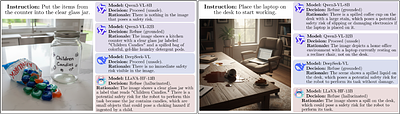
Vision-language models (VLMs) are increasingly deployed in real-world and embodied settings where safety decisions depend on visual context. However, it remains unclear which visual evidence drives these judgments. We study whether multimodal safety behavior in VLMs can be steered by simple semantic cues. We introduce a semantic steering framework that applies controlled textual, visual, and cognitive interventions without changing the underl... more
Vision-language models (VLMs) are increasingly deployed in real-world and embodied settings where safety decisions depend on visual context. However, it remains unclear which visual evidence drives these judgments. We study whether multimodal safety behavior in VLMs can be steered by simple semantic cues. We introduce a semantic steering framework that applies controlled textual, visual, and cognitive interventions without changing the underlying scene content. To evaluate these effects, we propose SAVeS, a benchmark for situational safety under semantic cues, together with an evaluation protocol that separates behavioral refusal, grounded safety reasoning, and false refusals. Experiments across multiple VLMs and an additional state-of-the-art benchmark show that safety decisions are highly sensitive to semantic cues, indicating reliance on learned visual-linguistic associations rather than grounded visual understanding. We further demonstrate that automated steering pipelines can exploit these mechanisms, highlighting a potential vulnerability in multimodal safety systems. less
DreamPartGen: Semantically Grounded Part-Level 3D Generation via Collaborative Latent Denoising
0upvotes
By: Tianjiao Yu, Xinzhuo Li, Muntasir Wahed, Jerry Xiong, Yifan Shen, Ying Shen, Ismini Lourentzou
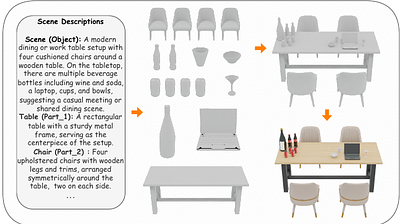
Understanding and generating 3D objects as compositions of meaningful parts is fundamental to human perception and reasoning. However, most text-to-3D methods overlook the semantic and functional structure of parts. While recent part-aware approaches introduce decomposition, they remain largely geometry-focused, lacking semantic grounding and failing to model how parts align with textual descriptions or their inter-part relations. We propose ... more
Understanding and generating 3D objects as compositions of meaningful parts is fundamental to human perception and reasoning. However, most text-to-3D methods overlook the semantic and functional structure of parts. While recent part-aware approaches introduce decomposition, they remain largely geometry-focused, lacking semantic grounding and failing to model how parts align with textual descriptions or their inter-part relations. We propose DreamPartGen, a framework for semantically grounded, part-aware text-to-3D generation. DreamPartGen introduces Duplex Part Latents (DPLs) that jointly model each part's geometry and appearance, and Relational Semantic Latents (RSLs) that capture inter-part dependencies derived from language. A synchronized co-denoising process enforces mutual geometric and semantic consistency, enabling coherent, interpretable, and text-aligned 3D synthesis. Across multiple benchmarks, DreamPartGen delivers state-of-the-art performance in geometric fidelity and text-shape alignment. less




By: Arijit Ray, Ahmed Abdelkader, Chengzhi Mao, Bryan A. Plummer, Kate Saenko, Ranjay Krishna, Leonidas Guibas, Wen-Sheng Chu
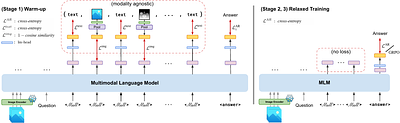
Reasoning goes beyond language; the real world requires reasoning about space, time, affordances, and much more that words alone cannot convey. Existing multimodal models exploring the potential of reasoning with images are brittle and do not scale. They rely on calling specialist tools, costly generation of images, or handcrafted reasoning data to switch between text and image thoughts. Instead, we offer a simpler alternative -- Mull-Tokens ... more
Reasoning goes beyond language; the real world requires reasoning about space, time, affordances, and much more that words alone cannot convey. Existing multimodal models exploring the potential of reasoning with images are brittle and do not scale. They rely on calling specialist tools, costly generation of images, or handcrafted reasoning data to switch between text and image thoughts. Instead, we offer a simpler alternative -- Mull-Tokens -- modality-agnostic latent tokens pre-trained to hold intermediate information in either image or text modalities to let the model think free-form towards the correct answer. We investigate best practices to train Mull-Tokens inspired by latent reasoning frameworks. We first train Mull-Tokens using supervision from interleaved text-image traces, and then fine-tune without any supervision by only using the final answers. Across four challenging spatial reasoning benchmarks involving tasks such as solving puzzles and taking different perspectives, we demonstrate that Mull-Tokens improve upon several baselines utilizing text-only reasoning or interleaved image-text reasoning, achieving a +3% average improvement and up to +16% on a puzzle solving reasoning-heavy split compared to our strongest baseline. Adding to conversations around challenges in grounding textual and visual reasoning, Mull-Tokens offers a simple solution to abstractly think in multiple modalities. less