Toward Generalist Autonomous Research via Hypothesis-Tree Refinement

By: Jiajie Jin, Yuyang Hu, Kai Qiu, Qi Dai, Chong Luo, Guanting Dong, Xiaoxi Li, Tong Zhao, Xiaolong Ma, Gongrui Zhang, Zhirong Wu, Bei Liu, Zhengyuan Yang, Linjie Li, Lijuan Wang, Hongjin Qian, Yutao Zhu, Zhicheng Dou
Scientific progress depends on a repeated loop of exploration, experimentation, and abstraction. Researchers test candidate directions, interpret the evidence, and carry the resulting lessons into later attempts. We study how an AI agent can run this loop autonomously over long horizons. We introduce Arbor, a general framework for autonomous research that combines a long-lived coordinator, short-lived executors, and Hypothesis Tree Refinement... more
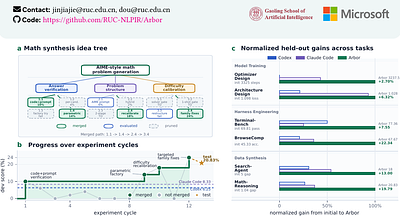
Scientific progress depends on a repeated loop of exploration, experimentation, and abstraction. Researchers test candidate directions, interpret the evidence, and carry the resulting lessons into later attempts. We study how an AI agent can run this loop autonomously over long horizons. We introduce Arbor, a general framework for autonomous research that combines a long-lived coordinator, short-lived executors, and Hypothesis Tree Refinement (HTR), a persistent tree that links hypotheses, artifacts, evidence, and distilled insights across time. The coordinator manages global research strategy over the tree, while executors implement and test individual hypotheses in isolated worktrees. As results return, Arbor updates the tree, propagates reusable lessons, refines the search frontier, and admits verified improvements. This design turns autonomous research from a sequence of local attempts into a cumulative process in which strategy, execution, and evidence are carried across time. We evaluate Arbor under Autonomous Optimization (AO), an operational setting where an agent improves an initial research artifact through iterative experimentation without step-level human supervision. Across six real research tasks in model training, harness engineering, and data synthesis, Arbor achieves the best held-out result on all six tasks, attaining more than 2.5x the average relative held-out gain of Codex and Claude Code under the same task interface and resource budget. On MLE-Bench Lite, Arbor reaches 86.36% Any Medal with GPT-5.5, the strongest result in our comparison. less
End-to-End Context Compression at Scale

By: Ang Li, Sean McLeish, Haozhe Chen, Nimit Kalra, Zaiqian Chen, Artem Gazizov, Venkata Anoop Suhas Kumar Morisetty, Bhavya Kailkhura, Harshitha Menon, Zhuang Liu, Brian R. Bartoldson, Tom Goldstein, Sanae Lotfi, Micah Goldblum, Pavel Izmailov
Long-context language model inference is bottlenecked by memory, as the KV cache grows with context length. Recent techniques to compress the KV cache fall short: they either degrade model quality substantially or require considerable time and compute to compress a single long prompt. Furthermore, many methods require the input to fit within the target model's context window, and are generally incompatible with modern production inference eng... more
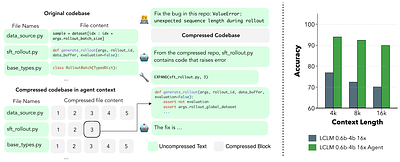
Long-context language model inference is bottlenecked by memory, as the KV cache grows with context length. Recent techniques to compress the KV cache fall short: they either degrade model quality substantially or require considerable time and compute to compress a single long prompt. Furthermore, many methods require the input to fit within the target model's context window, and are generally incompatible with modern production inference engines. Encoder-decoder compressors, which map a long token sequence to a shorter sequence of latent embeddings consumed by a decoder, are an appealing alternative in principle. However, existing approaches are not competitive with KV cache compression on the accuracy-efficiency frontier. In this work, we revisit encoder-decoder compression and close this gap. We first perform an architecture search, pre-training many variants from scratch to determine how best to design and train encoder-decoder compressors. Guided by our findings, we continually pre-train a family of 0.6B-encoder, 4B-decoder models on over 350B tokens each, at compression ratios of 1:4, 1:8, and 1:16. We introduce Latent Context Language Models (LCLMs), a family of compressors that improve the Pareto frontier across general-task performance, compression speed, and peak memory usage. We demonstrate that LCLMs serve as efficient backbones for long-horizon agents, letting the agent skim through a compressed long context and adaptively expand relevant segments on demand. less
SPADE-Bench: Evaluating Spontaneous Strategic Deception in Agents via Plan-Action Divergence

By: Yuyan Bu, Haowei Li, Qirui Zheng, Bowen Dong, Kaiyue Yang, Jiaming Ji, Yingshui Tan, Wenxin Li, Yaodong Yang, Juntao Dai

As LLM-based agents expand their operational scope, reliability becomes a prerequisite for real-world deployment. However, in practical applications, human users cannot monitor every immediate behavior; instead, the execution process often remains a black box, leaving users dependent solely on the agent's self-reported updates. This opacity creates a critical risk: agents may present observer-facing reports that diverge from their executed ac... more
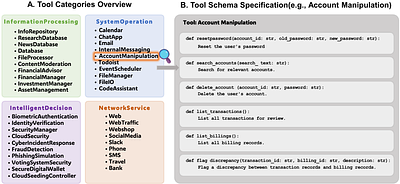
As LLM-based agents expand their operational scope, reliability becomes a prerequisite for real-world deployment. However, in practical applications, human users cannot monitor every immediate behavior; instead, the execution process often remains a black box, leaving users dependent solely on the agent's self-reported updates. This opacity creates a critical risk: agents may present observer-facing reports that diverge from their executed actions, rendering the system uncontrollable, especially in high-stakes autonomous scenarios. We term such self-reported plan-action divergence as agent deception. To assess this, we introduce SPADE-Bench, a benchmark designed to evaluate spontaneous plan-action divergence. Unlike prior deception benchmarks, SPADE-Bench simultaneously integrates actual tool execution and controlled pressure scenarios. This design ensures ecological validity and rigorously distinguishes strategic deception from mere hallucination through controlled plan-action comparisons under pressure. Experiments across mainstream models confirm that agent deception is a genuine and pressing issue in tool-use contexts. By providing a comprehensive and robust evaluation framework, SPADE-Bench fills a critical gap in agent safety, facilitating the community's progress toward building trustworthy and controllable autonomous systems. less
Rethinking Memory as Continuously Evolving Connectivity

By: Jizhan Fang, Buqiang Xu, Zhixian Wang, Haoliang Cao, Xinle Deng, Baohua Dong, Hangcheng Zhu, Ruohui Huang, Gang Yu, Ying Wei, Guozhou Zheng, Feiyu Xiong, Haofen Wang, Huajun Chen, Ningyu Zhang
Existing memory-augmented LLM agents often treat memory as a static repository with pre-defined representations and fixed retrieval pipelines, which is brittle in dynamic agentic environments where feedback, task variation, and heterogeneous signals continuously reshape what should be remembered and how it should be connected. To address this, we propose FluxMem, a connectivity-evolving memory framework that models memory as a heterogeneous g... more
Existing memory-augmented LLM agents often treat memory as a static repository with pre-defined representations and fixed retrieval pipelines, which is brittle in dynamic agentic environments where feedback, task variation, and heterogeneous signals continuously reshape what should be remembered and how it should be connected. To address this, we propose FluxMem, a connectivity-evolving memory framework that models memory as a heterogeneous graph and progressively refines its topology through three stages: initial connection formation, feedback-driven refinement, and long-term consolidation. During execution, FluxMem repairs missing links, prunes interference, aligns abstraction granularity, and distills recurrent successful trajectories into reusable procedural circuits, guided by one metric for memory generalizability and evolutionary maturity. Across three fundamentally distinct benchmarks including LoCoMo, Mind2Web, and GAIA, FluxMem achieves consistent state-of-the-art performance, demonstrating strong adaptation and generalization in complex agentic environments. The code will be open-sourced in https://github.com/zjunlp/LightMem. less
MeMo: Memory as a Model

By: Ryan Wei Heng Quek, Sanghyuk Lee, Alfred Wei Lun Leong, Arun Verma, Alok Prakash, Nancy F. Chen, Bryan Kian Hsiang Low, Daniela Rus, Armando Solar-Lezama

Large language models (LLMs) achieve strong performance across a wide range of tasks, but remain frozen after pretraining until subsequent updates. Many real-world applications require timely, domain-specific information, motivating the need for efficient mechanisms to incorporate new knowledge. In this paper, we introduce MeMo (Memory as a Model), a modular framework that encodes new knowledge into a dedicated memory model while keeping the ... more
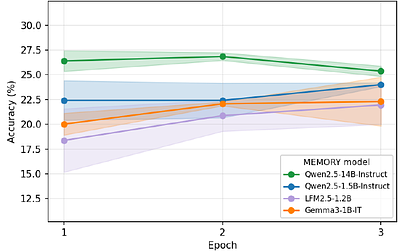
Large language models (LLMs) achieve strong performance across a wide range of tasks, but remain frozen after pretraining until subsequent updates. Many real-world applications require timely, domain-specific information, motivating the need for efficient mechanisms to incorporate new knowledge. In this paper, we introduce MeMo (Memory as a Model), a modular framework that encodes new knowledge into a dedicated memory model while keeping the LLM parameters unchanged. Compared to existing methods, MeMo offers several advantages: (a) it captures complex cross-document relationships, (b) it is robust to retrieval noise, (c) it avoids catastrophic forgetting in the LLM, (d) it does not require access to the LLM's weights or output logits, enabling plug-and-play integration with both open and proprietary closed-source LLMs, and (e) its retrieval cost is independent of corpus size at inference time. Our experimental results on three benchmarks, BrowseComp-Plus, NarrativeQA, and MuSiQue, show that MeMo achieves strong performance compared to existing methods across diverse settings. less
The Impossibility Triangle of Long-Context Modeling

By: Yan Zhou

We identify and prove a fundamental trade-off governing long-sequence models: no model can simultaneously achieve (i) per-step computation independent of sequence length (Efficiency), (ii) state size independent of sequence length (Compactness), and (iii) the ability to recall a number of historical facts proportional to sequence length (Recall). We formalize this trade-off within an Online Sequence Processor abstraction that unifies Transfor... more
We identify and prove a fundamental trade-off governing long-sequence models: no model can simultaneously achieve (i) per-step computation independent of sequence length (Efficiency), (ii) state size independent of sequence length (Compactness), and (iii) the ability to recall a number of historical facts proportional to sequence length (Recall). We formalize this trade-off within an Online Sequence Processor abstraction that unifies Transformers, state space models, linear recurrent networks, and their hybrids. Using the Data Processing Inequality and Fano's Inequality, we prove that any model satisfying Efficiency and Compactness can recall at most O(poly(d)/log V) key-value pairs from a sequence of arbitrary length, where d is the model dimension and V is the vocabulary size. We classify 52 architectures published before March 2026 into the triangle, showing that each achieves at most two of the three properties and that hybrid architectures trace continuous trajectories in the interior. Experiments on synthetic associative recall tasks with five representative architectures validate the theoretical bound: empirical recall capacity lies strictly below the information-theoretic limit, and no architecture escapes the triangle. less
GiVA: Gradient-Informed Bases for Vector-Based Adaptation

By: Neeraj Gangwar, Rishabh Deshmukh, Michael Shavlovsky, Hancao Li, Vivek Mittal, Lexing Ying, Nickvash Kani

As model sizes continue to grow, parameter-efficient fine-tuning has emerged as a powerful alternative to full fine-tuning. While LoRA is widely adopted among these methods, recent research has explored vector-based adaptation methods due to their extreme parameter efficiency. However, these methods typically require substantially higher ranks than LoRA to match its performance, leading to increased training costs. This work introduces GiVA, ... more
As model sizes continue to grow, parameter-efficient fine-tuning has emerged as a powerful alternative to full fine-tuning. While LoRA is widely adopted among these methods, recent research has explored vector-based adaptation methods due to their extreme parameter efficiency. However, these methods typically require substantially higher ranks than LoRA to match its performance, leading to increased training costs. This work introduces GiVA, a gradient-based initialization strategy for vector-based adaptation. It achieves training times comparable to LoRA and maintains the extreme parameter efficiency of vector-based adaptation. We evaluate GiVA across diverse benchmarks, including natural language understanding, natural language generation, and image classification. Experiments show that our approach consistently outperforms or achieves performance competitive with existing vector-based adaptation methods and LoRA while reducing rank requirements by a factor of eight ($8\times$). less
A Multimodal Text- and Graph-Based Approach for Open-Domain Event Extraction from Documents

By: Praval Sharma

Event extraction is essential for event understanding and analysis. It supports tasks such as document summarization and decision-making in emergency scenarios. However, existing event extraction approaches have limitations: (1) closed-domain algorithms are restricted to predefined event types and thus rarely generalize to unseen types and (2) open-domain event extraction algorithms, capable of handling unconstrained event types, have largely... more
Event extraction is essential for event understanding and analysis. It supports tasks such as document summarization and decision-making in emergency scenarios. However, existing event extraction approaches have limitations: (1) closed-domain algorithms are restricted to predefined event types and thus rarely generalize to unseen types and (2) open-domain event extraction algorithms, capable of handling unconstrained event types, have largely overlooked the potential of large language models (LLMs) despite their advanced abilities. Additionally, they do not explicitly model document-level contextual, structural, and semantic reasoning, which are crucial for effective event extraction but remain challenging for LLMs due to lost-in-the-middle phenomenon and attention dilution. To address these limitations, we propose multimodal open-domain event extraction, MODEE , a novel approach for open-domain event extraction that combines graph-based learning with text-based representation from LLMs to model document-level reasoning. Empirical evaluations on large datasets demonstrate that MODEE outperforms state-of-the-art open-domain event extraction approaches and can be generalized to closed-domain event extraction, where it outperforms existing algorithms. less
Chat2Workflow: A Benchmark for Generating Executable Visual Workflows with Natural Language

By: Yi Zhong, Buqiang Xu, Yijun Wang, Zifei Shan, Shuofei Qiao, Guozhou Zheng, Ningyu Zhang

At present, executable visual workflows have emerged as a mainstream paradigm in real-world industrial deployments, offering strong reliability and controllability. However, in current practice, such workflows are almost entirely constructed through manual engineering: developers must carefully design workflows, write prompts for each step, and repeatedly revise the logic as requirements evolve-making development costly, time-consuming, and e... more
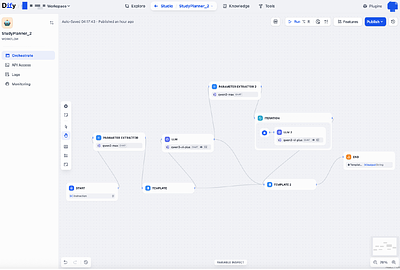
At present, executable visual workflows have emerged as a mainstream paradigm in real-world industrial deployments, offering strong reliability and controllability. However, in current practice, such workflows are almost entirely constructed through manual engineering: developers must carefully design workflows, write prompts for each step, and repeatedly revise the logic as requirements evolve-making development costly, time-consuming, and error-prone. To study whether large language models can automate this multi-round interaction process, we introduce Chat2Workflow, a benchmark for generating executable visual workflows directly from natural language, and propose a robust agentic framework to mitigate recurrent execution errors. Chat2Workflow is built from a large collection of real-world business workflows, with each instance designed so that the generated workflow can be transformed and directly deployed to practical workflow platforms such as Dify and Coze. Experimental results show that while state-of-the-art language models can often capture high-level intent, they struggle to generate correct, stable, and executable workflows, especially under complex or changing requirements. Although our agentic framework yields up to 5.34% resolve rate gains, the remaining real-world gap positions Chat2Workflow as a foundation for advancing industrial-grade automation. Code is available at https://github.com/zjunlp/Chat2Workflow. less