Rethinking Memory as Continuously Evolving Connectivity

By: Jizhan Fang, Buqiang Xu, Zhixian Wang, Haoliang Cao, Xinle Deng, Baohua Dong, Hangcheng Zhu, Ruohui Huang, Gang Yu, Ying Wei, Guozhou Zheng, Feiyu Xiong, Haofen Wang, Huajun Chen, Ningyu Zhang
Existing memory-augmented LLM agents often treat memory as a static repository with pre-defined representations and fixed retrieval pipelines, which is brittle in dynamic agentic environments where feedback, task variation, and heterogeneous signals continuously reshape what should be remembered and how it should be connected. To address this, we propose FluxMem, a connectivity-evolving memory framework that models memory as a heterogeneous g... more
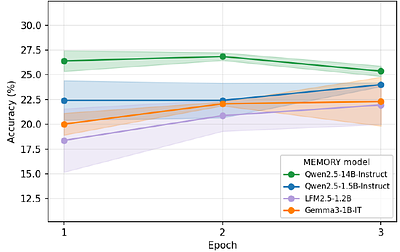
Existing memory-augmented LLM agents often treat memory as a static repository with pre-defined representations and fixed retrieval pipelines, which is brittle in dynamic agentic environments where feedback, task variation, and heterogeneous signals continuously reshape what should be remembered and how it should be connected. To address this, we propose FluxMem, a connectivity-evolving memory framework that models memory as a heterogeneous graph and progressively refines its topology through three stages: initial connection formation, feedback-driven refinement, and long-term consolidation. During execution, FluxMem repairs missing links, prunes interference, aligns abstraction granularity, and distills recurrent successful trajectories into reusable procedural circuits, guided by one metric for memory generalizability and evolutionary maturity. Across three fundamentally distinct benchmarks including LoCoMo, Mind2Web, and GAIA, FluxMem achieves consistent state-of-the-art performance, demonstrating strong adaptation and generalization in complex agentic environments. The code will be open-sourced in https://github.com/zjunlp/LightMem. less
MeMo: Memory as a Model

By: Ryan Wei Heng Quek, Sanghyuk Lee, Alfred Wei Lun Leong, Arun Verma, Alok Prakash, Nancy F. Chen, Bryan Kian Hsiang Low, Daniela Rus, Armando Solar-Lezama

Large language models (LLMs) achieve strong performance across a wide range of tasks, but remain frozen after pretraining until subsequent updates. Many real-world applications require timely, domain-specific information, motivating the need for efficient mechanisms to incorporate new knowledge. In this paper, we introduce MeMo (Memory as a Model), a modular framework that encodes new knowledge into a dedicated memory model while keeping the ... more
Large language models (LLMs) achieve strong performance across a wide range of tasks, but remain frozen after pretraining until subsequent updates. Many real-world applications require timely, domain-specific information, motivating the need for efficient mechanisms to incorporate new knowledge. In this paper, we introduce MeMo (Memory as a Model), a modular framework that encodes new knowledge into a dedicated memory model while keeping the LLM parameters unchanged. Compared to existing methods, MeMo offers several advantages: (a) it captures complex cross-document relationships, (b) it is robust to retrieval noise, (c) it avoids catastrophic forgetting in the LLM, (d) it does not require access to the LLM's weights or output logits, enabling plug-and-play integration with both open and proprietary closed-source LLMs, and (e) its retrieval cost is independent of corpus size at inference time. Our experimental results on three benchmarks, BrowseComp-Plus, NarrativeQA, and MuSiQue, show that MeMo achieves strong performance compared to existing methods across diverse settings. less
The Impossibility Triangle of Long-Context Modeling

By: Yan Zhou

We identify and prove a fundamental trade-off governing long-sequence models: no model can simultaneously achieve (i) per-step computation independent of sequence length (Efficiency), (ii) state size independent of sequence length (Compactness), and (iii) the ability to recall a number of historical facts proportional to sequence length (Recall). We formalize this trade-off within an Online Sequence Processor abstraction that unifies Transfor... more
We identify and prove a fundamental trade-off governing long-sequence models: no model can simultaneously achieve (i) per-step computation independent of sequence length (Efficiency), (ii) state size independent of sequence length (Compactness), and (iii) the ability to recall a number of historical facts proportional to sequence length (Recall). We formalize this trade-off within an Online Sequence Processor abstraction that unifies Transformers, state space models, linear recurrent networks, and their hybrids. Using the Data Processing Inequality and Fano's Inequality, we prove that any model satisfying Efficiency and Compactness can recall at most O(poly(d)/log V) key-value pairs from a sequence of arbitrary length, where d is the model dimension and V is the vocabulary size. We classify 52 architectures published before March 2026 into the triangle, showing that each achieves at most two of the three properties and that hybrid architectures trace continuous trajectories in the interior. Experiments on synthetic associative recall tasks with five representative architectures validate the theoretical bound: empirical recall capacity lies strictly below the information-theoretic limit, and no architecture escapes the triangle. less
GiVA: Gradient-Informed Bases for Vector-Based Adaptation

By: Neeraj Gangwar, Rishabh Deshmukh, Michael Shavlovsky, Hancao Li, Vivek Mittal, Lexing Ying, Nickvash Kani

As model sizes continue to grow, parameter-efficient fine-tuning has emerged as a powerful alternative to full fine-tuning. While LoRA is widely adopted among these methods, recent research has explored vector-based adaptation methods due to their extreme parameter efficiency. However, these methods typically require substantially higher ranks than LoRA to match its performance, leading to increased training costs. This work introduces GiVA, ... more
As model sizes continue to grow, parameter-efficient fine-tuning has emerged as a powerful alternative to full fine-tuning. While LoRA is widely adopted among these methods, recent research has explored vector-based adaptation methods due to their extreme parameter efficiency. However, these methods typically require substantially higher ranks than LoRA to match its performance, leading to increased training costs. This work introduces GiVA, a gradient-based initialization strategy for vector-based adaptation. It achieves training times comparable to LoRA and maintains the extreme parameter efficiency of vector-based adaptation. We evaluate GiVA across diverse benchmarks, including natural language understanding, natural language generation, and image classification. Experiments show that our approach consistently outperforms or achieves performance competitive with existing vector-based adaptation methods and LoRA while reducing rank requirements by a factor of eight ($8\times$). less
A Multimodal Text- and Graph-Based Approach for Open-Domain Event Extraction from Documents

By: Praval Sharma

Event extraction is essential for event understanding and analysis. It supports tasks such as document summarization and decision-making in emergency scenarios. However, existing event extraction approaches have limitations: (1) closed-domain algorithms are restricted to predefined event types and thus rarely generalize to unseen types and (2) open-domain event extraction algorithms, capable of handling unconstrained event types, have largely... more
Event extraction is essential for event understanding and analysis. It supports tasks such as document summarization and decision-making in emergency scenarios. However, existing event extraction approaches have limitations: (1) closed-domain algorithms are restricted to predefined event types and thus rarely generalize to unseen types and (2) open-domain event extraction algorithms, capable of handling unconstrained event types, have largely overlooked the potential of large language models (LLMs) despite their advanced abilities. Additionally, they do not explicitly model document-level contextual, structural, and semantic reasoning, which are crucial for effective event extraction but remain challenging for LLMs due to lost-in-the-middle phenomenon and attention dilution. To address these limitations, we propose multimodal open-domain event extraction, MODEE , a novel approach for open-domain event extraction that combines graph-based learning with text-based representation from LLMs to model document-level reasoning. Empirical evaluations on large datasets demonstrate that MODEE outperforms state-of-the-art open-domain event extraction approaches and can be generalized to closed-domain event extraction, where it outperforms existing algorithms. less
Chat2Workflow: A Benchmark for Generating Executable Visual Workflows with Natural Language

By: Yi Zhong, Buqiang Xu, Yijun Wang, Zifei Shan, Shuofei Qiao, Guozhou Zheng, Ningyu Zhang

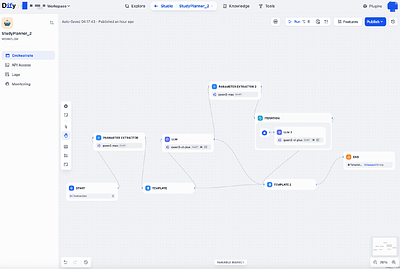
At present, executable visual workflows have emerged as a mainstream paradigm in real-world industrial deployments, offering strong reliability and controllability. However, in current practice, such workflows are almost entirely constructed through manual engineering: developers must carefully design workflows, write prompts for each step, and repeatedly revise the logic as requirements evolve-making development costly, time-consuming, and e... more
At present, executable visual workflows have emerged as a mainstream paradigm in real-world industrial deployments, offering strong reliability and controllability. However, in current practice, such workflows are almost entirely constructed through manual engineering: developers must carefully design workflows, write prompts for each step, and repeatedly revise the logic as requirements evolve-making development costly, time-consuming, and error-prone. To study whether large language models can automate this multi-round interaction process, we introduce Chat2Workflow, a benchmark for generating executable visual workflows directly from natural language, and propose a robust agentic framework to mitigate recurrent execution errors. Chat2Workflow is built from a large collection of real-world business workflows, with each instance designed so that the generated workflow can be transformed and directly deployed to practical workflow platforms such as Dify and Coze. Experimental results show that while state-of-the-art language models can often capture high-level intent, they struggle to generate correct, stable, and executable workflows, especially under complex or changing requirements. Although our agentic framework yields up to 5.34% resolve rate gains, the remaining real-world gap positions Chat2Workflow as a foundation for advancing industrial-grade automation. Code is available at https://github.com/zjunlp/Chat2Workflow. less
Demystifying OPD: Length Inflation and Stabilization Strategies for Large Language Models

By: Feng Luo, Yu-Neng Chuang, Guanchu Wang, Zicheng Xu, Xiaotian Han, Tianyi Zhang, Vladimir Braverman
On-policy distillation (OPD) trains student models under their own induced distribution while leveraging supervision from stronger teachers. We identify a failure mode of OPD: as training progresses, on-policy rollouts can undergo abrupt length inflation, causing truncated trajectories to dominate the training data. This truncation collapse coincides with abrupt repetition saturation and induces biased gradient signals, leading to severe trai... more
On-policy distillation (OPD) trains student models under their own induced distribution while leveraging supervision from stronger teachers. We identify a failure mode of OPD: as training progresses, on-policy rollouts can undergo abrupt length inflation, causing truncated trajectories to dominate the training data. This truncation collapse coincides with abrupt repetition saturation and induces biased gradient signals, leading to severe training instability and sharp degradation in validation performance. We attribute this problem to the interaction between student-induced data collection and the distillation objective, which implicitly favors long and repetitive rollouts. To address this issue, we propose StableOPD, a stabilized OPD framework that combines a reference-based divergence constraint with rollout mixture distillation. These together mitigate repetition-induced length inflation and further stabilize OPD training. Across multiple math reasoning datasets, our approach prevents truncation collapse, stabilizes training dynamics, and improves performance by 7.2% on average. less
ClawBench: Can AI Agents Complete Everyday Online Tasks?

By: Yuxuan Zhang, Yubo Wang, Yipeng Zhu, Penghui Du, Junwen Miao, Xuan Lu, Wendong Xu, Yunzhuo Hao, Songcheng Cai, Xiaochen Wang, Huaisong Zhang, Xian Wu, Yi Lu, Minyi Lei, Kai Zou, Huifeng Yin, Ping Nie, Liang Chen, Dongfu Jiang, Wenhu Chen, Kelsey R. Allen
AI agents may be able to automate your inbox, but can they automate other routine aspects of your life? Everyday online tasks offer a realistic yet unsolved testbed for evaluating the next generation of AI agents. To this end, we introduce ClawBench, an evaluation framework of 153 simple tasks that people need to accomplish regularly in their lives and work, spanning 144 live platforms across 15 categories, from completing purchases and booki... more
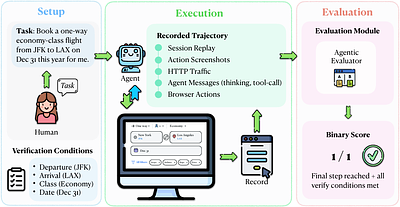
AI agents may be able to automate your inbox, but can they automate other routine aspects of your life? Everyday online tasks offer a realistic yet unsolved testbed for evaluating the next generation of AI agents. To this end, we introduce ClawBench, an evaluation framework of 153 simple tasks that people need to accomplish regularly in their lives and work, spanning 144 live platforms across 15 categories, from completing purchases and booking appointments to submitting job applications. These tasks require demanding capabilities beyond existing benchmarks, such as obtaining relevant information from user-provided documents, navigating multi-step workflows across diverse platforms, and write-heavy operations like filling in many detailed forms correctly. Unlike existing benchmarks that evaluate agents in offline sandboxes with static pages, ClawBench operates on production websites, preserving the full complexity, dynamic nature, and challenges of real-world web interaction. A lightweight interception layer captures and blocks only the final submission request, ensuring safe evaluation without real-world side effects. Our evaluations of 7 frontier models show that both proprietary and open-source models can complete only a small portion of these tasks. For example, Claude Sonnet 4.6 achieves only 33.3%. Progress on ClawBench brings us closer to AI agents that can function as reliable general-purpose assistants. less
Synthetic Sandbox for Training Machine Learning Engineering Agents

By: Yuhang Zhou, Lizhu Zhang, Yifan Wu, Jiayi Liu, Xiangjun Fan, Zhuokai Zhao, Hong Yan

As large language model agents advance beyond software engineering (SWE) tasks toward machine learning engineering (MLE), verifying agent behavior becomes orders of magnitude more expensive: while SWE tasks can be verified via fast-executing unit tests, MLE verification requires running full ML pipelines -- data preprocessing, model training, and metric evaluation -- on large datasets at each rollout step, rendering trajectory-wise on-policy ... more
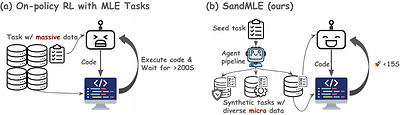
As large language model agents advance beyond software engineering (SWE) tasks toward machine learning engineering (MLE), verifying agent behavior becomes orders of magnitude more expensive: while SWE tasks can be verified via fast-executing unit tests, MLE verification requires running full ML pipelines -- data preprocessing, model training, and metric evaluation -- on large datasets at each rollout step, rendering trajectory-wise on-policy reinforcement learning (RL) prohibitively slow. Existing approaches retreat to supervised fine-tuning (SFT) or offline proxy rewards, sacrificing the exploration and generalization benefits of on-policy RL. We observe that sandbox data size is the primary source of this bottleneck. Based on this insight, we introduce SandMLE, a multi-agent framework that generates diverse, verifiable synthetic MLE environments from a small number of seed tasks, preserving the structural and technical complexity of real-world problems while constraining datasets to micro-scale (each task is paired with only 50-200 training samples). Through extensive experiments, we show that SandMLE reduces execution time by over 13 times, enabling large-scale, on-policy trajectory-wise RL for the first time in the MLE domain. On MLE-bench-lite, SandMLE yields significant gains over SFT baselines across Qwen3-8B, 14B, and 30B-A3B, with relative medal rate improvements ranging from 20.3% to 66.9%. Furthermore, the trained policy generalizes across unseen agentic scaffolds, achieving up to 32.4% better HumanRank score on MLE-Dojo. less