Return of the clocked burster GS~1826$-$238

Return of the clocked burster GS~1826$-$238
Tomoshi Takeda, Toru Tamagawa, Teruaki Enoto, Wataru Iwakiri, Akira Dohi, Tatehiro Mihara, Hiromitsu Takahashi, Chin-Ping Hu, Amira Aoyama, Naoyuki Ota, Satoko Iwata, Takuya Takahashi, Kaede Yamasaki, Takayuki Kita, Soma Tsuchiya, Yosuke Nakano, Mayu Ichibakase, Nobuya Nishimura
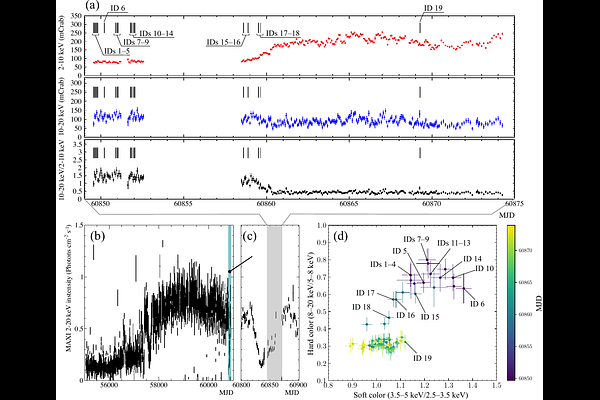
AbstractWe report the discovery of an exceptionally short burst recurrence time in the well-known clocked burster GS~1826$-$238, observed with the CubeSat X-ray observatory NinjaSat. The source had remained in a persistent soft spectral state since its hard-to-soft transition in 2015 July until a soft-to-hard transition occurred in 2025 May. On 2025 June 23, NinjaSat began monitoring GS~1826$-$238 in the hard state and continued until the source returned to a steady soft state. During this period, we detected 19 X-ray bursts: 14 during the hard state, 4 in the transitional state, and 1 in the soft state. In the hard state, we identified a new clocked bursting epoch, during which the burst recurrence time remained highly stable and unprecedentedly short among the clocked bursting phases of GS~1826$-$238, with $t_{\rm rec} = 1.603 \pm 0.040$~hr~($1\sigma$ error). Furthermore, this recurrence time deviates significantly by approximately~37\% from the previously established empirical relation $t_{\rm rec} \propto F_{\rm bol}^{-1.05}$, where $F_{\rm bol}$ is the bolometric persistent flux. These results suggest that the ignition conditions for X-ray bursts differed from those in earlier epochs. We explore possible explanations for this discrepancy and propose a scenario in which a smaller fraction of the neutron star surface was involved in fuel accumulation and nuclear burning. This situation leads to a high local accretion rate compared to earlier epochs, which naturally results in the exceptionally short recurrence time, as well as the observed reductions of approximately 38\% in blackbody normalization (proportional to the emitting area) and 29\% in burst fluence.