The Debris Disk Host $β$ Piscis Austrinus is a Rapidly Rotating Star Seen Nearly Pole-On

The Debris Disk Host $β$ Piscis Austrinus is a Rapidly Rotating Star Seen Nearly Pole-On
Colin Kane, Russel White, Jeremy Jones, Benjamin Montesinos, Sebastian Carrazco-Gaxiola, Tim Johns, Aman Kar, Wei-Chun Jao, Todd Henry
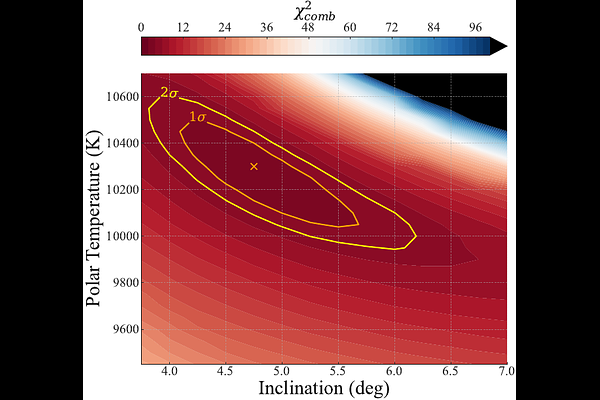
AbstractPrevious studies of $β$ Piscis Austrinus (PsA) have speculated that the narrow and saddle-like shapes of some of its weak metallic lines are a consequence of it being a rapidly rotating star viewed nearly pole-on. Here we use the \texttt{fastrot-spec} spectral synthesis code to model high-dispersion (R = 115,000) HARPS spectra of $β$ PsA in order to determine its inclination and photospheric properties, with additional constraints on the surface temperature set by measures of Fe II/Fe I line ratios. The analysis confirms that $β$ PsA is oriented nearly pole-on ($i = 4.75^{+0.75}_{-0.50}$$^o$) and experiences substantial gravity darkening caused by its rapid rotation ($Ω/Ω_{crit}=0.93\pm0.17$). $β$ PsA has a polar temperature of $10300^{+200}_{-250}$ K that is 24% hotter than its equatorial temperature ($8275^{+317}_{-400}$ K). This results in its apparent luminosity being 48% larger than its actual luminosity of 26.2$^{+1.9}_{-2.4}$ L$_\odot$. When this methodology is applied to high-dispersion spectra of the star Vega, the analysis determines a nearly pole-on orientation that is consistent with interferometric measurements, validating the technique. Based on comparisons with PARSEC evolutionary models of stars rotating at similar velocities, $β$ PsA has a mass of $2.20\pm0.03$ M$_{\odot}$ and an age of $141^{+113}_{-49}$ Myr; this age is consistent with the age inferred for its G5V companion star, CD-32 17127, based on lithium depletion models. The analysis demonstrates the potential for both identifying and determining the stellar properties of rapidly rotating stars viewed nearly pole-on via spectroscopy alone.