The Effect of Asphericity to the Inference of Supernova Circumstellar Environment from Radio Observations

The Effect of Asphericity to the Inference of Supernova Circumstellar Environment from Radio Observations
Ryotaro Chiba, Zhengwei Liu, Takashi J. Moriya, Xiaolong Yang
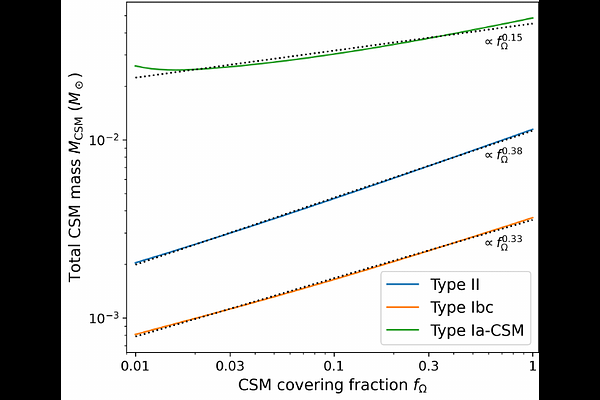
AbstractRadio observations of supernovae (SNe) enable us to constrain the circumstellar environment of their progenitor stars, and hence the mass-loss history immediately prior to the explosion. However, despite lines of evidence pointing to the aspherical configurations of circumstellar matter (CSM) around many SNe, the derivation of CSM parameters is often done under the assumption of spherically symmetric CSM. In this work, based on a recent model of radio emission from SNe interacting with aspherical CSM, we investigate how lifting the assumption of spherical symmetry affects the CSM parameter inference. First, we apply the model to mock data simulating typical observations of Type Ia-CSM, Ibc and II SNe and find that the total CSM mass required for to reproduce radio observation depends weakly on the CSM covering fraction $f_Ω$, with ${f_Ω}^{0.15-0.38}$. We then apply the model and fit the radio light curves of Type Ia-CSM SN 2020eyj. We show that, even with the assumption of asphericity as severe as $f_Ω= 0.1$, the requirement for the total CSM mass is only reduced to $\sim 50 \%$ of the value inferred in spherical models. These results demonstrate that introducing asphericity in radio emission models is often not enough to reduce the required CSM mass significantly.