Three-dimensional transport-induced chemistry on temperate sub-Neptune K2-18b, Part II: the combined effects of atmospheric dynamics and chemical reactions

Three-dimensional transport-induced chemistry on temperate sub-Neptune K2-18b, Part II: the combined effects of atmospheric dynamics and chemical reactions
Jiachen Liu, Duncan Christie, Jun Yang, Krisztian Kohary
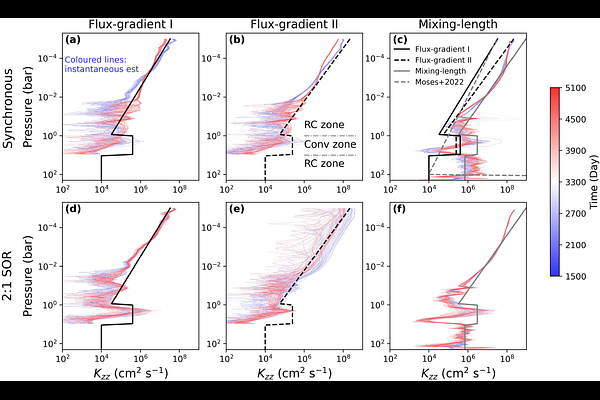
AbstractThe upper atmospheres of temperate sub-Neptunes are strongly influenced by atmospheric dynamics due to their cool equilibrium temperature and thereby longer chemical timescales than the atmospheric dynamical timescales. In this study, we used a three-dimensional (3D) general circulation model to investigate the transport-induced disequilibrium chemistry and vertical mixing on temperate gas-rich mini-Neptunes, using K2-18b as an example. We model K2-18b assuming 180 times solar metallicity and consider it as either a synchronous or an asynchronous rotator, exploring spin-orbit resonances of 2:1, 6:1, and 10:1. We find that the vertical transport affects the chemical structure significantly, making CO$_2$ and CO more abundant ($\sim$10$^{-3}$) in the upper atmosphere compared to the chemical equilibrium abundance (<10$^{-15}$), and horizontal winds further homogenize the chemical composition zonally in this region. Molecular abundances in the photosphere generally agree across different rotation periods. We employ a passive tracer in the model to estimate the one-dimensional (1D) equivalent eddy-diffusion coefficient ($K_{zz}$) of K2-18b, providing a parameter useful for future 1D atmospheric models. Additionally, synthetic transmission spectra generated from our model are compared with the JWST observations, and we find that our model can provide a comparable fit to the observations. This work offers a 3D perspective on transport-induced chemistry on a temperate sub-Neptune and derives vertical mixing parameters to support 1D modelling.