Metal-Poor Gas Accretion Drives Giant Clump Formation at 0.6 < z < 2.6

Metal-Poor Gas Accretion Drives Giant Clump Formation at 0.6 < z < 2.6
Visal Sok, Adam Muzzin, Ben Forrest, Gillian Wilson, Jialu Chen, Vivian Yun Yan Tan, Sunna Withers, Roberto Abraham, Maruša Bradač, Vicente Estrada-Carpenter, Kartheik G. Iyer, Nicholas S. Martis, Gaël Noirot, Ghassan T. E. Sarrouh, Marcin Sawicki, Chris J. Willott, Aurélien Henry, Naadiyah Jagga, Danilo Marchesini, Ian McConachie, Katherine Myers, Nelson Nunes, Luke Robbins
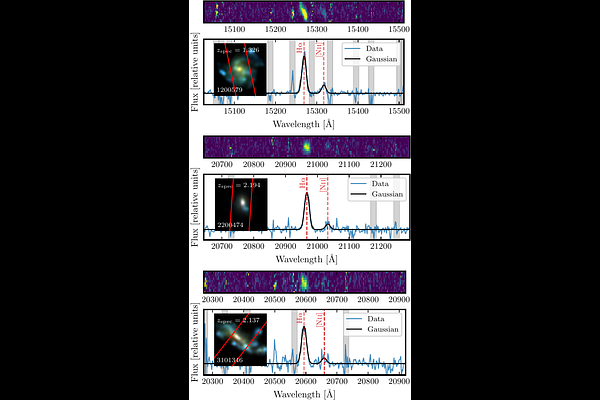
AbstractThe physical properties of kiloparsec-scale clumps in high-redshift star-forming galaxies (SFGs) contain crucial constraints on how they assemble. Building on recent work that indicates the presence of a metallicity offset in clumpy galaxies compared to nonclumpy SFGs, we analyze the chemical abundance in a large sample of ${\sim}300$ SFGs between $0.6<z<2.6$ using LEGA-C, MOSDEF and CANUCS near-infrared spectroscopic observations. We find that clumpy galaxies generally have lower gas-phase metallcities compared to the mass-metallicity relation, while nonclumpy galaxies have higher metallicities. We further investigate the relationship between the resolved stellar properties of clumps and the integrated gas-phase metallicity of the host galaxies using a subset of galaxies observed in the CANUCS fields. In particular, clumps in SFGs with metallicity below the mass-metallicity relation (i.e., $ΔZ \leq 0$) are generally younger and have higher SFRs, compared to clumps whose host galaxies have $ΔZ > 0$. We do not find a significant mass difference between these two clump populations. Finally, we compute the merger statistic using the Gini-M20 morphological parameters and find that the majority of clumpy galaxies are not classified as mergers based on their stellar mass maps. The results suggest that the clumpy nature of cosmic noon galaxies is linked to metal-poor gas accretion events that trigger star formation and dilute metallicities.