Assessing the performance of future space-based detectors: astrophysical foregrounds and individual sources

Assessing the performance of future space-based detectors: astrophysical foregrounds and individual sources
Alice Perego, Matteo Bonetti, Alberto Sesana, Silvia Toonen, Valeriya Korol
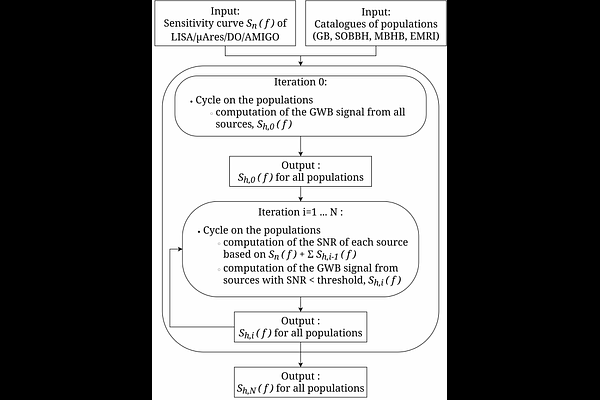
AbstractThe space mission LISA (Laser Interferometer Space Antenna), scheduled for launch in 2035, aims to detect gravitational wave (GW) signals in the milli-Hz band. In the context of ESA Voyage 2050 Call for new mission concepts, other frequency ranges are explored by the Gravitational-Wave Space 2050 Working Group to conceive new proposals for a post-LISA space-based detector. In this work, we give a preliminary estimate of the observational potential of three mission designs proposed in the literature, namely $\mu$Ares, AMIGO and the Decihertz Observatory. The analysis framework includes astrophysical GW sources such as massive black hole binaries, extreme mass-ratio inspirals and compact binaries such as stellar black holes and white dwarfs. For each detector, we first present a consistent computation of the unresolved gravitational wave background (GWB) produced by the sum of all anticipated astrophysical populations, using an iterative subtraction algorithm. We then investigate which types of systems are the most appealing, by measuring the number of GW signals detected and exploring the source properties.