The major merger-active galactic nucleus connection up to the cosmic noon

The major merger-active galactic nucleus connection up to the cosmic noon
A. La Marca, B. Margalef-Bentabol, L. Wang, S. C. Trager, V. Rodriguez-Gomez, G. Martin
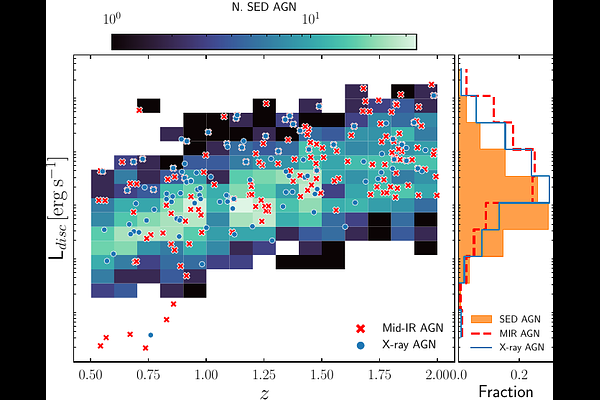
AbstractGalaxy major mergers are a potential mechanism for triggering active galactic nuclei (AGN) activity, but their role remains debated, particularly beyond the local Universe. We aim to shed light on the merger-AGN connection at $z=0.5$-$2$, exploiting the multi-wavelength datasets and {\it James Webb Space Telescope} (JWST) observations in the COSMOS field. We construct a stellar mass-limited sample and identify AGN via mid-infrared (MIR) colours, X-ray detections, and spectral energy distribution (SED) fitting. We train convolutional neural networks to identify mergers with mock JWST observations. We create non-AGN and non-merger control samples matching the redshift, stellar mass, and star-formation rate distributions of the AGN and mergers. We find AGN to be moderately more frequent in mergers than in non-mergers, with excess ratios ranging from $\sim2.5$ (X-ray AGN) to $\sim1.3$ (MIR) and $\sim 1.1$-1.2 (SED AGN). Similarly, AGN galaxies show a higher merger fraction ($f_{merg}$) than non-AGN controls. We then study $f_{merg}$ as a function of relative and absolute AGN power, utilising the AGN fraction ($f_{AGN}$) and accretion disc luminosity (L$_{disc}$) parameters. We uncover a $f_{merg}$-$f_{AGN}$ relation with two regimes: $f_{merg}$ stays roughly flat for less-dominant AGN ($f_{AGN}<0.8$) but increases at $f_{AGN}>0.8$ for the MIR and X-ray AGN, and more gently for SED AGN, where mergers appear to be the main triggering mechanism. Additionally, $f_{merg}$ increases monotonically as a function of L$_{disc}$, for all AGN types, reaching $f_{merg}>50\%$ for the most luminous AGN (L$_{disc} \gtrsim 10^{46}\,{erg\,s^{-1}}$). Overall, our results suggest that major mergers can trigger AGN out to the cosmic noon at $z\sim2$. Furthermore, the role of major mergers shows a clear dependence on AGN luminosity and remains the principal mechanism for fuelling the most powerful AGN.