Exploring Physics beyond the Standard Model from kHz-Gravitational-Wave Signals of Core-Collapse Supernovae

Exploring Physics beyond the Standard Model from kHz-Gravitational-Wave Signals of Core-Collapse Supernovae
Kei Kotake, Takami Kuroda
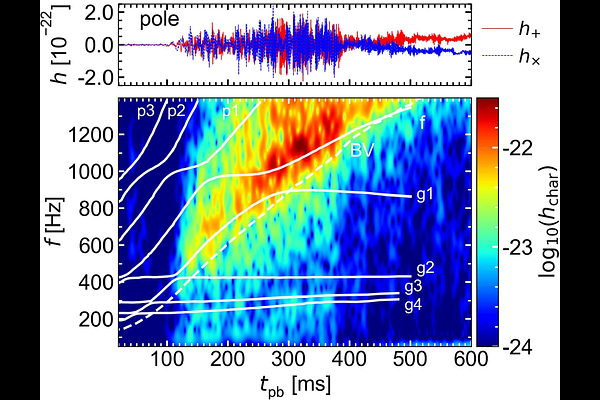
AbstractRecent advances in multidimensional modeling of core-collapse supernovae (CCSNe) have enabled detailed predictions of high-frequency gravitational-wave (GW) signals, offering a new probe of extreme matter and gravity. A proto-neutron star (PNS) emits quasi-continuous GWs through the excitation of its characteristic oscillation modes. State-of-the-art CCSN simulations show that these oscillations, in particular $g$- and $f$-modes, dominate the GW spectrum, with frequencies rising from a few hundred hertz to the kilohertz (kHz) range as the PNS compactness increases in the post-bounce phase. Therefore, the temporal evolution of these GW frequencies, if detected, would provide a direct and quantitative tracer of the PNS internal structure and the surrounding explosive dynamics. In addition to such standard GW emission mechanism, fully general relativistic (GR) simulations have revealed additional GW sources linked to more exotic physical processes. In highly massive progenitors, continuous mass accretion drives rapid PNS contraction and early black-hole (BH) formation, producing strong kHz GW emission that abruptly ceases when the PNS core is swallowed by the BH horizon. Similarly, a strong first-order quantum chromodynamics (QCD) phase transition can induce a secondary collapse and rebound of the nascent quark core, generating powerful, millisecond-duration GW bursts with frequencies exceeding $\sim$2 kHz. Alternative theories of gravity, such as scalar-tensor frameworks, predict spontaneous scalarization that can trigger multiple collapses of the PNS, yielding analogous high-frequency and broadband GW signals. The combined analysis of these GW signals, together with their detection by next-generation GW detectors, offers a promising multi-messenger pathway to identify smoking-gun signatures of new physics beyond the standard model of the CCSN GW mechanism and general relativity.