Novel insights on the Coma Cluster kinematics with DESI. I. Linking mass profile, orbital anisotropy and galaxy populations

Novel insights on the Coma Cluster kinematics with DESI. I. Linking mass profile, orbital anisotropy and galaxy populations
S. Pedratti, L. Pizzuti, M. Fossati, A. Biviano, A. Boselli, A. Ragagnin, A. Carlin
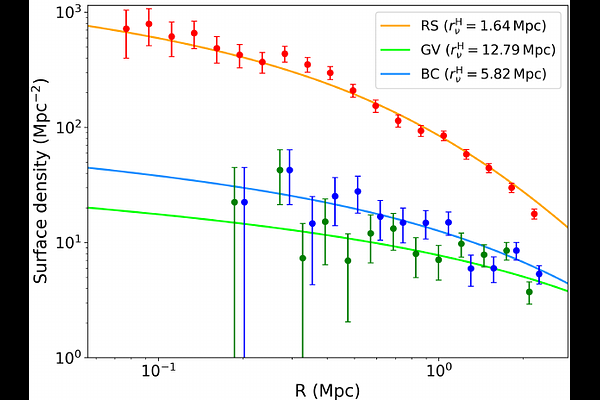
AbstractWe investigate the kinematic properties of the Coma galaxy cluster using a new, large spectroscopic sample of member galaxies, from the Dark Energy Spectroscopic Instrument (DESI). By means of the MG-MAMPOSSt code, based on the Jeans equation, we jointly reconstruct the total cluster mass profile and the velocity anisotropy profile. Assuming a Navarro-Frenk-White model, we estimate a virial mass $M_{200}=1.08_{-0.09}^{+0.08}~({\rm stat})\pm 0.09~({\rm syst})\times 10^{15}\,\mathrm{M}_\odot $, corresponding to $r_{200}=2.12 \pm 0.06\,\mathrm{Mpc}$ and a scale radius for the mass profile $r_{\rm s}=0.48^{+0.27}_{-0.13}\,\mathrm{Mpc}$, which provides the tightest robust kinematic mass profile constraint to date. By considering separately the mass of the hot gas and the galaxy stellar mass, we determine the dark matter mass profile, with $M_{200}^{\rm DM}=8.6^{+1.2}_{-0.8}\times 10^{14}\,\text{M}_\odot$. We discuss the impact of the mass and number density parametrisations, the effect of different choices of the cluster's rest frame and of the radial range of the kinematic analysis, further comparing our results with previous estimates from the literature. The cluster dynamical state has also been assessed, using the spatial and line-of-sight velocity distributions of the members. We perform a kinematic study of different subsamples of galaxy populations, based on their colour (red sequence, green valley, and blue cloud), focusing on the anisotropy profiles and line-of-sight velocity distributions. The orbits of green valley and blue cloud galaxies appear to be more radial in the centre and in the outskirts, respectively, with the latter predicting a higher cluster virial mass. This study provides new insights on the interplay between dynamical and intrinsic properties of galaxies in massive structures, fundamental to verify the tight connection between galaxy evolution and environment.