First Lunar Farside SETI Observations for Periodic Signals with the Low-frequency Radio Spectrometer of Chang'E-4 Mission

First Lunar Farside SETI Observations for Periodic Signals with the Low-frequency Radio Spectrometer of Chang'E-4 Mission
Jian-Kang Li, Zhen-Zhao Tao, Bo-Lun Huang, Kang-Jiao, Tong-Jie Zhang, Ming-Yuan Wang, Jin-Song Ping
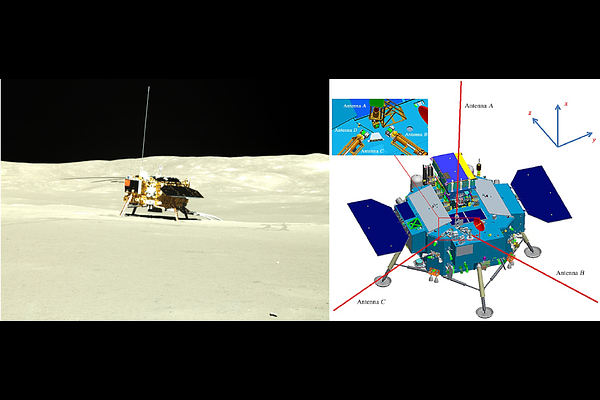
AbstractChang'E-4 (CE4), the first mission to soft-land on the lunar farside, provides a unique opportunity for astronomical observations from an environment shielded from terrestrial radio interference, and thus serves as pathfinder for lunar farside radio search for extraterrestrial intelligence (SETI) studies. We present a search for periodic technosignatures using low-frequency radio observations from the CE-4 mission, the first radio SETI study based on data from on the observation in lunar farside. We analyze the CE4 dynamic spectra with a component-level framework that combines principal component analysis (PCA), cross-antenna basis alignment, as well as temporal periodicity and frequency comb structure diagnostics. No final periodic candidate signal is found after the selection procedure, and we therefore find no evidence in the present CE4 sample for a credible periodic artificial signal. This study serves as a pathfinder and provides a practical framework for lunar radio SETI analysis. As more future lunar missions begin to incorporate radio instrumentation, lunar farside may become a promising site for expanding radio SETI research.