Masses of Potentially Habitable Planets Characterized by the Habitable Worlds Observatory

Masses of Potentially Habitable Planets Characterized by the Habitable Worlds Observatory
Kaz Gary, B. Scott Gaudi, Eduardo Bendek, Tyler Robinson, Renyu Hu, Breann Sitarski, Aki Roberge, Eric Mamajek
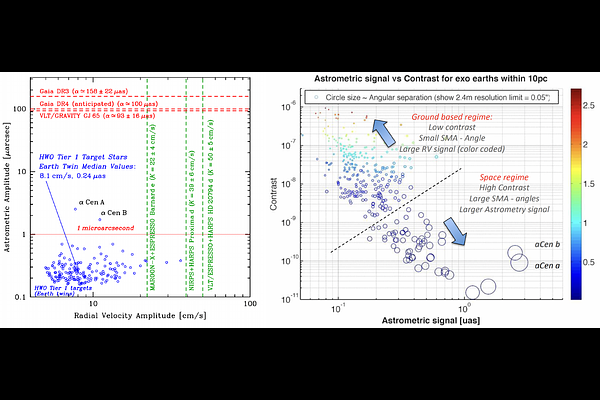
AbstractConstraints on the masses of exoplanets directly imaged and characterized by the Habitable Worlds Observatory (HWO) are crucial for categorizing these planets and interpreting their spectra. In particular, achieving a mass measurement with a precision of approximately 10% or better may be necessary to identify the dominant gaseous species in the atmospheres of Earth-like planets. This is essential for assessing their habitability and interpreting potential biosignatures (arXiv:2502.01513). Space-based astrometry will be required to measure the masses of planets in face-on systems, or planets orbiting hot and rapidly rotating or highly active stars. Astrometric uncertainties are dominated by the number and magnitude of background reference stars needed to precisely measure the astrometric wobble of the target star induced by the planet. To that end, we propose a program to measure the masses of Earth analogs orbiting HWO target stars with ultra-high-precision astrometry obtained with the HWO high-resolution instrument. We assess the photon-noise error budget for these observations. We find that, for a field of view spanning a few square arcminutes, the astrometric uncertainty due to the number and brightness of reference stars dominates the photon-noise error budget, particularly for targets near the Galactic poles. We explored the impact of filter choice and location in the sky on the photon-noise astrometric uncertainties by simulating the magnitude distribution of reference stars across different filters at a range of galactic longitudes and latitudes. We find that a ~ 200-day survey in the Gaia G band consisting of 100 epochs per target star distributed over the 5-year prime mission with a 6m aperture HWO equipped with a 6' x 6' field-of-view would be required to achieve the photon-noise sensitivity to measure the masses of the ~ 40 Earth-mass habitable-zone planets to ~10%.