SIRIUS: The relation between the diversity of dwarf galaxies and their formation histories

SIRIUS: The relation between the diversity of dwarf galaxies and their formation histories
Chi-Hong Lin, Michiko S Fujii, Takayuki R Saitoh, Yutaka Hirai
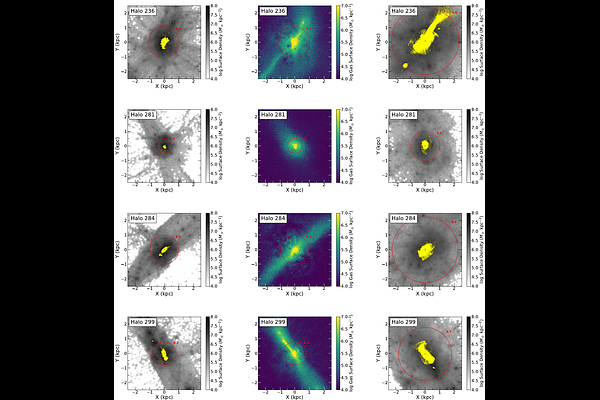
AbstractLow-mass dwarf galaxies ($M_{\rm vir} \lesssim 10^9\rm\ M_\odot$) are fundamental cosmological building blocks, yet the physical processes driving their structural diversity remain poorly understood. Recent numerical simulations have suggested a diversity in the stellar-to-halo mass ratio in this halo mass range, but either the number of samples obtained from the same simulation setup or the numerical resolution was limited. We performed high-resolution cosmological zoom-in simulations for eight galaxies with a dark matter halo mass of $\sim 10^9\rm\ M_{\odot}$ up to $t=1.2$ Gyr at which most gas in the galaxies has been expelled. Our samples have a scatter of an order of magnitude in the halo mass at the reionization epoch. The stellar-to-halo mass ratio expected at $z=0$ scatters nearly two orders of magnitude with $5\times10^{-5}$ to $2\times10^{-3}$. We also observed variation in the compactness of their stellar distributions. Some of our simulated galaxies exhibit a stellar half-mass radius of $\sim30$ pc, which is as small as that of ultra-compact dwarfs. The formation condition for such a compact stellar distribution is understood as an analog of the condition for the formation of dense, massive star clusters. We found that when the central gas surface density exceeds a critical threshold ($Σ_{\rm gas} \gtrsim 30\rm\ M_\odot \rm\ {pc}^{-2}$), the star formation becomes highly efficient and results in dense stellar systems. These results suggest that UCDs can form in situ even in isolated dark matter halos.