Fast radio bursts track cosmic star formation history with time delay: the effect of burst fluence

Fast radio bursts track cosmic star formation history with time delay: the effect of burst fluence
X. D. Jia, D. H. Zhai, J. P. Hu, S. X. Yi, F. Y. Wang
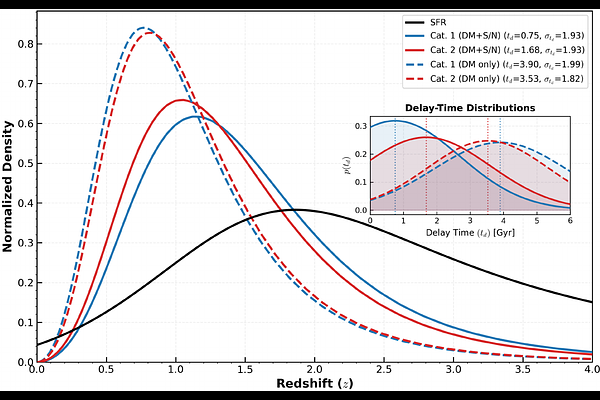
AbstractFast radio bursts (FRBs) are luminous millisecond-duration radio transients of extragalactic origin, yet their progenitor systems remain unidentified. The redshift evolution of the FRB event rate provides a powerful, model-independent discriminant between young progenitors and old progenitors, but recent studies have reached conflicting conclusions. In this work, we perform a forward-modeling analysis of the apparent non-repeating FRB sample from the CHIME/FRB catalogs to constrain the intrinsic FRB population. We find that the FRB rate follows the star formation rate (SFR) with little time delay when both dispersion measure (DM) and fluence are considered. In contrast, when only DM is taken into account, a significant time delay ($3 \sim 4$ Gyr) exists between the FRB rate and the SFR. The main reason for this discrepancy is that systematic biases exist in the mapping process from burst fluence to signal-to-noise ratio. These results support that at least a fraction of FRBs arise from a progenitor population whose event rate is delayed relative to star formation.