Magnetic Power in Binaries: From Coalescing Binary Neutron Stars to Close-in Exoplanetary Systems

Magnetic Power in Binaries: From Coalescing Binary Neutron Stars to Close-in Exoplanetary Systems
Dong Lai, Tu Guo, Nicholas Corso
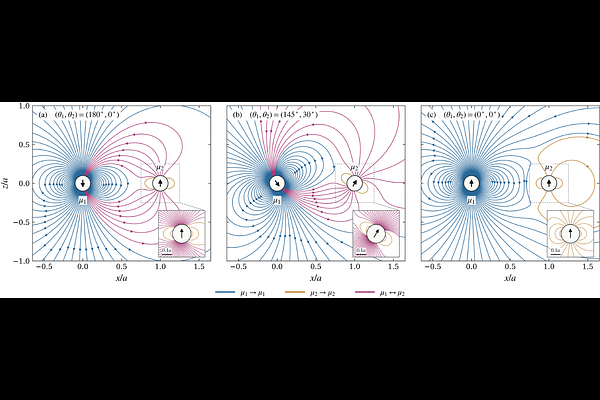
AbstractA binary system containing two magnetic components ("stars") can be modeled as a circuit powered by the orbital motion, with the magnetic field lines linking the two stars serving as wires. When the total resistance in the binary components is small -- as found in many astrophysical systems such as binary neutron stars and extra-solar hot-Jupiter or super-Earth systems -- the connected field lines are twisted and open up in a quasi-cyclic manner, leading to quasi-periodic energy dissipation and flares. We derive analytic expressions for the average and episodic magnetic powers from such systems, providing a quantitative description on how the powers depend on the magnetic orientations of the two stars. The power can be much larger than in the case where one of the stars has a negligible magnetic field. It may manifest as pre-merger quasi-cyclic flares in coalescing neutron-star binaries and as orbit-regulated radio emissions in exoplanetary systems.