Panchromatic View of the Frigid Jovian Exoplanet COCONUTS-2 b

Panchromatic View of the Frigid Jovian Exoplanet COCONUTS-2 b
Matthieu Ravet, Mickaël Bonnefoy, Gaël Chauvin, Zhoujian Zhang, Jacqueline K. Faherty, Maël Voyer, Mark W. Phillips, Pascal Tremblin, Rocio Kiman, Jessica Copeland, James J. Mang, Caroline V. Morley, Helena Kühnle, Benjamin Charnay, Sam de Regt, Paul Mollière, Simon Petrus, Allan Denis, Alice Radcliffe, Paulina Palma-Bifani, Arthur Vigan, Mathilde Mâlin, Gabriel-Dominique Marleau, Elena Manjavacas, Kevin Hoy, Elisabeth C. Matthews, Thomas K. Henning
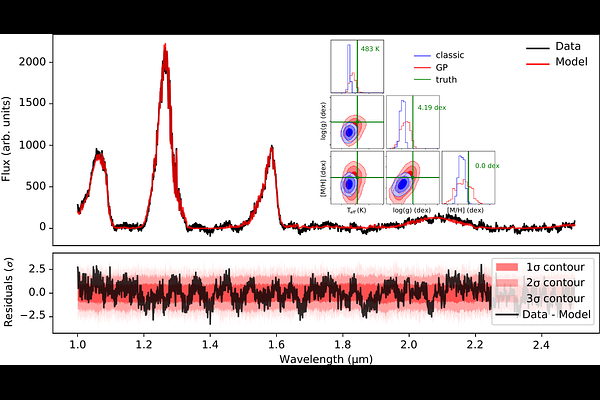
AbstractWe use a high signal-to-noise MIRI-LRS spectrum (5.45 - 11 $μ$m, R$_λ$ $\sim100$) of COCONUTS-2~b revealing prominent molecular features of H$_2$O, CH$_4$ and NH$_3$. This dataset is combined with spectra from Gemini/FLAMINGOS-2 and JWST/NIRSpec (G395H), as well as photometry from WISE and Spitzer, resulting in almost continuous wavelength coverage from 1 to 15 $μ$m. We analyze the data using five grids of self-consistent atmospheric models, spanning a wide range of T$_\text{eff}$, log(g), and [M/H]. We also investigate the use of Gaussian Processes to account for correlated noise either caused by the spectrograph or by systematic departures of models in the inversion framework. All models manage to fit the overall combined observations but predict fainter flux in Y- and N-bands. Classical model comparison suggests that the ATMO2020++ synthetic specra (with and without PH$_3$) are statistically preferred. Fitting for the correlated noise of the three spectroscopic instruments, ATMO2020++ models yields constraints consistent with previous studies and evolutionary models predictions: T$_\text{eff}$ $=496^{+5}_{-3}$ K, log(g) $=4.30^{+0.04}_{-0.02}$ dex, [M/H] $=-0.02^{+0.03}_{-0.02}$ dex, and R $=1.03^{+0.01}_{-0.02}$ R$_\text{jup}$. The extended wavelength coverage provided by MIRI (accounting for 41% of the bolometric flux) completes the SED, yielding a precise luminosity estimation of log(L/L$_{\odot}$) $=-6.166\pm0.002$ dex. Combined with a previous estimate of the system age ($414\pm23$ Myr), cooling models predict a mass of M $=7.3\pm0.3$ M$_\text{jup}$.