Possible chemical signatures of first-star enrichment in a very metal-poor galaxy overdensity near the end of reionization

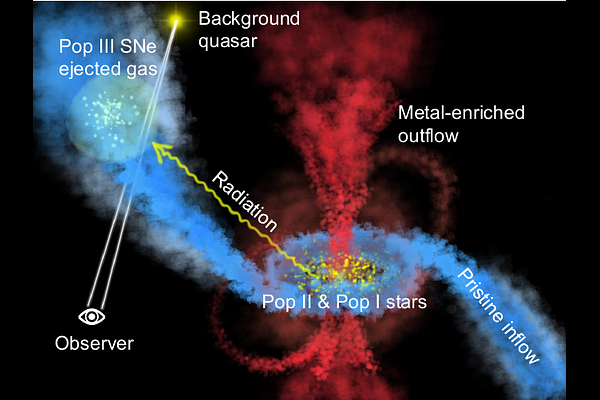
Possible chemical signatures of first-star enrichment in a very metal-poor galaxy overdensity near the end of reionization
Zihao Li, Koki Kakiichi, Lise Christensen, Zheng Cai, Valentina D'Odorico, Jorryt Matthee, Daichi Kashino, Rongmon Bordoloi, Ruari Mackenzie, Trystyn A. M. Berg, Irene Vanni, Stefania Salvadori, Alessandra Venditti, Shiwu Zhang, Sarah E. I. Bosman, Eduardo Bañados, Frederick B. Davies, Xiaohui Fan, Hyunsung Jun, Xiangyu Jin, Mingyu Li, Sofía Rojas-Ruiz, Feige Wang, Jinyi Yang, Siwei Zou, Huanian Zhang, Yongda Zhu
AbstractThe first generation of stars, known as Population III (Pop III), formed from primordial gas consisting solely of hydrogen and helium and is believed to have emerged only a few hundred million years after the Big Bang. Detecting the chemical enrichment of metal-poor circumgalactic gas offers a promising way to trace the enrichment signature of Pop III stars. Along the sightline to the quasar SDSS J0100+2802, a metal absorber at $z = 5.945$, showing over-abundant carbon and silicon compared to solar, has been reported to be consistent with the enrichment pattern of Pop III stars. With the James Webb Space Telescope, we report the discovery of an unusually metal-poor galaxy overdensity of 17 members (mean metallicity $\approx 3\%$ solar) near this metal absorber, which is $\sim 0.4$ dex more metal-poor than coeval galaxies in similarly overdense environments. This less chemically evolved system may have provided favorable conditions for preserving the absorption signatures of Pop III enrichment. The cross-correlation of the metal absorber and the surrounding galaxies indicates a minimum dark matter halo of $\log(M_{\mathrm{h,min}}/M_{\odot})=10.68^{+0.93}_{-1.72}$, consistent with late-time Pop III formation at the outskirts of atomic hydrogen cooling halos.