Mock Observations: Morphological Analysis of Galactic Bars in IllustrisTNG Simulations

Mock Observations: Morphological Analysis of Galactic Bars in IllustrisTNG Simulations
Jun-Yu Gong, Weipeng Lin, Weishan Zhu, Lin Tang
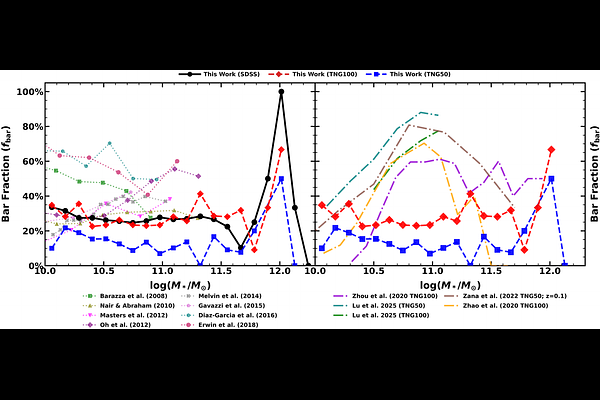
AbstractGalactic bars are important tracers of disk-galaxy evolution, yet reported bar fractions vary among observational studies and between observations and cosmological simulations. We compare bar statistics and properties in the IllustrisTNG simulations(TNG100 and TNG50 at z~0.1) with Sloan Digital Sky Survey(SDSS) galaxies at0.1<=z<=0.1264. We generate synthetic r-band TNG images,match SDSS observational conditions,and analyze mock TNG and real SDSS images using a common image-based framework of source segmentation,morphological classification, and isophotal ellipse fitting. For face-on late-type galaxies with log(M*/Msun)>10,the global bar fractions are 26.68+/-0.23%,24.96(-.76/+.78)%, and 13.42(-1.07/+1.15)% for SDSS,TNG100,and TNG50,respectively. TNG100 broadly agrees with SDSS over 10^10<~M*<~10^11.2Msun but shows a higher fbar at higher masses, whereas TNG50 remains lower than SDSS over most of10^10<~M*<~10^11.7Msun. Bulge-disk decompositions show fewer high-n bulges in TNG100 than in SDSS,particularly at high masses,but more in TNG50. These differences in bulge concentration may contribute to the different bar fractions. Bar length generally increases with stellar mass,and this trend depends little on the adopted bar-length definition. However, the outer ellipticity-decline estimator(R0.85max) yields systematically larger bar lengths than the ellipticity-peak estimator (R(eps,max)^bar). Massive TNG100 galaxies have more extended stellar disks than SDSS,which may contribute to their smaller relative bar lengths(Rbar/Re). Our results indicate that observational conditions,sample selection,and bar-identification methodology can affect the inferred bar fraction,emphasizing comparable observational conditions and analysis procedures in simulation-observation comparisons. Our SDSS measurements may underestimate the bar fraction relative to observations with higher spatial resolution.