Rapid Orbital Decay of Supersoft X-Ray Source WX Cen: a Surrounding Circumbinary Disk

Rapid Orbital Decay of Supersoft X-Ray Source WX Cen: a Surrounding Circumbinary Disk
Zhi-Qiang Liu, Wei-Min Liu, Wen-Cong Chen
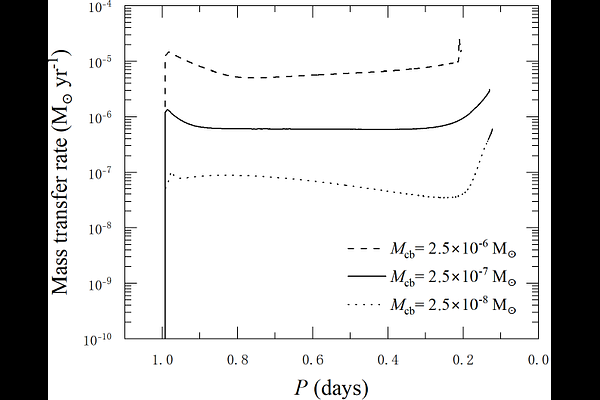
AbstractWX Cen is most likely a candidate of compact binary supersoft X-ray sources, which consists of a white dwarf (WD) and a donor star that fills the Roche lobe. Recently, this source was detected to be experiencing a rapid orbital decay at a rate of $\dot{P} =-(4.4\pm0.4)\times10^{-7}~ \rm days~\rm{yr}^{-1}$. According to the mass function and optical eclipses, the donor-star mass can be constrained to be $0.41-0.44$, $0.47-0.50$, and $0.55-0.59~M_\odot$ when the WD mass is $0.7$, $0.9$, and $1.2~M_\odot$, respectively. The observed orbital period derivative cannot be produced by the angular momentum loss due to mass loss during the accretion of the WD, magnetic braking (MB) mechanisms, including standard MB, convection and rotation-enhanced MB, and anomalous MB prescriptions. We propose that the rapid orbital decay of WX Cen is caused by the tidal torque that originates from the resonant interaction between the binary and a surrounding circumbinary (CB) disk. Detailed stellar evolution models indicate that a WD binary with a $2.5 \times 10^{-7}~M_{\odot}$ CB disk can evolve toward a WX Cen-like system, which has an orbital period derivative of $\dot{P}=-4.0\times10^{-7}~ \rm days~\rm{yr}^{-1}$ and a relatively high mass-transfer rate of $5.3\times10^{-7}~M_\odot\rm yr^{-1}$ that can trigger a stable hydrogen burning process on the surface of the WD.